
Who doesn't love a good teambuilding event? It turns out, a significant number of people. A recent survey of more than 1,000 American workers by Citrix and Wakefield Research found that 31 percent said they disliked such activities. Anyone who has ever been reluctantly roped into a silly office contest can probably think of a few reasons why workers might begrudge these experiences. This can be an even bigger concern at a meeting or an executive retreat, where concerns about making the best use of attendees' limited time are even more pronounced.
But the fact is that teambuilding, if done right, can be broadly effective. Researchers at the University of Central Florida analyzed data from 103 separate studies conducted between 1950 and 2007, and found that teambuilding does indeed make measurable improvements on team performance. The issue is not whether teambuilding works, but what kind of teambuilding works.
"An exercise that is simply a fun day away from the office produces little return on investment three months after the retreat," says Dianne Crampton, founder of TIGERS Success Series, Inc., a management-consulting firm based in Bend, OR. "Couple that with increasing employee desire for work-life balance, and you might find employees calling in sick the day of the event." Fun-focused teambuilding activities can be a good time, but at the end of the day, it can be difficult for company leadership to pinpoint exactly what value the organization gains from it. Crampton points to her company's own internal survey of more than 2,800 HR professionals. It found that while there can be a short-term spike of morale based on the aura of fun, this does not translate into long-term improvements in skills, attitudes, or behavior.
It doesn't have to be this way. By setting out clear goals, tailoring activities to attendees, and conducting effective pre- and post-event evaluations, a company can get quite a lot out of a teambuilding event.
Dress Rehearsal
Ben Dattner, Ph.D., executive coach and principal of New York City-based Dattner Consulting, as well as a professor of organizational development at New York University, sees ineffective teambuilding as the result of misalignment between a company's goals and the activity.
"If you want to create a sense of shared team spirit, you really don't want to be doing paintball, where attendees are hunting down their co-workers in the forest, or on a go-kart track trying to beat each other to a finish line," says Dattner. "That is exactly the opposite of what you are trying to create back in the organization."
Instead, Dattner urges companies to think of a teambuilding event as a "dress rehearsal" for the "final performance" of what they will be doing when they return to work. If the company leadership wants to see more openness and transparency in the organization, those things need to be the focus of the off-site event.
"A successful teambuilding activity creates temporary conditions that encourages behaviours you hope will become permanent when the group returns home," says Dattner. "You're going to the off-site to do a run-through, then take the show back [to the office]."
"Teambuilding should be viewed as a means to an end, not the end in itself," says Bryan Mattimore, cofounder of Norwalk, CT-based Growth Engine, which offers consulting and creates off-site programs for corporate clients.
Mattimore gives the example of an event Growth Engine coordinated for financial services firm FiServ, aimed at sharing leads and building new revenue streams for the organization. It brought together 125 senior executives from eight of the company's divisions, putting them through a series of creative exercises to help them identify cross-divisional sales opportunities.
"At the end of the day, we had the group put a dollar figure on what they thought these new cross-selling ideas would be worth," says Mattimore. "The group estimated as much as $125 million in new sales. A year later, when we checked back with the VP of sales, they had realized $72 million of the $125 million."
Mattimore emphasizes that "creating something new together" can be a powerful experience when teambuilding. A strong example of this was an event his company put together for Benefit Cosmetics (owned by luxury-brand company LVMH). Growth Engine gathered 150 regional sales reps and store managers to help devise store-activation ideas for some of the company's new products. Using a process that Growth Engine has called "brainwalking," they set up 25 "ideation stations" around the room. Teams of six would go to each station and start writing up a new idea.
"Then, in a kind of 'idea volleyball,' we had teams rotate to their neighbors' station, and build on their ideas," says Mattimore. "Then several more rotations took place, until finally they rotated back to their original station and circled the ideas they liked, including their original ideas."
Not only did this activity prove productive, generating hundreds of ideas in about 45 minutes, but the effort to build on one-another's ideas created the kind of "role playing" that the company leadership hoped to see when attendees returned to the office.
Know Your Audience
Just as teambuilding can fall short when the goals are not in alignment, similar issues come up if the specific audience is not taken into account. Puzzle-solving might be fun for cerebral attendees but could bore those who prefer to be more active. Athletic activities may delight some but send others into a panic.
Alison Green, a management expert who co-authored the book Managing to Change the World, sees this as a major hurdle for teambuilding. "Many people hate them," she says of off-site activities. "They hate them because the company chooses activities that violate people's dignity or privacy, or because something the company intends to be 'fun' is actually miserable for some people."
Green urges planners to give preference to activities that are "voluntary and low-key," keeping in mind that activities that might be fun with friends are not always appropriate in the workplace.
"Teambuilding inherently moves people and teams out of their comfort zones, to seeing themselves and others, and their work process in a new way," says Kate Stockton, president of Philadelphia-based Stockton & Partners Meetings & Events. "The mechanism for creating this 'discomfort,' if you will, requires collaboration between our team and the client to assure the method is the right one."
This requires looking at questions such as the level of physicality attendees would be comfortable with, and what their roles are within the organization. The last thing a planner will want to do is push participants so far outside of their comfort zone that they feel alienated or even embarrassed.
"First on the agenda should be establishing ground rules of respectful communication and a 'right to pass' if one doesn't feel comfortable contributing," says Lara Steel, director of Work Life Innovations, based in Australia as well as Jackson, MS. "It's usually good to normalize the idea that they can request a break or leave the room if it's getting a bit heavy or too far out of their comfort zones."
Steel adds that facilitators must be "constantly reading the 'process' of the group" to ensure that participants are feeling engaged and not criticized or left out. Even if blunt honesty is a goal of the event, the facilitator should be clear on how negativity is acceptable and should have a strategy for breaking the tension should things get uncomfortable.
Of course, even the best-designed program is not going to solve major organizational problems. If there is a serious communication or morale problem at the company, those need to first be dealt with at the top of the organization. "Those are issues that require management to step in and take action; they can't be fixed with rope-climbing or trust falls," says Green. "And in fact, trying to use teambuilding in those contexts can make the problems worse, because employees quite rightly will be frustrated that they're being asked to spend their time on frivolous activities while the real issues are unaddressed."
Kjerulf agrees. "If a team has real problems, we have to solve those problems in the workplace," he says. "Taking the team out for unrelated activities, however fun they may be, is unlikely to work."
And once the event takes place, it is essential for the leaders to do the proper follow-up. "Many a corporation has spent tens of thousands of dollars on leadership, teambuilding, and retreats where everyone has a great time and enjoys the activities... but then they never speak of it again," says Steel. "Everyone goes back to work on Monday, usually paying dearly for the time out of the office by being hit with a mountain of emails."
Steel says the company must avoid considering the "warm and fuzzy" feeling as the sole sign of a successful teambuilding, as the everyday pressures of work will eventually pull staff back into old habits. Instead, it may be worthwhile to regroup for a "consolidation session" two to four weeks after the initial gathering. "You really need to get internal team members to take on some of the tasks of keeping it front of mind," says Steel. "If there's no follow-up, long-term learning and change is highly unlikely, and therefore there's no ROI."
Questions or comments? Email [email protected]
This article appears in the August 2015 issue of Successful Meetings.
Competing to Lose
Perhaps the most common error made by those organizing a teambuilding event is opting to make the activity competitive when that's the opposite of leadership's intended goal.
"Most organizations want employees to collaborate and communicate better, but then they focus the activity around competition that puts pressure on people," says Lain Hensely, COO of Odyssey Teams, a Chico, CA-based company that organizes philanthropic and team-building opportunities. "In return, employees' reflexive response is to exhibit the very negative behaviors the company is trying to inhibit -- they undermine each other and they don't collaborate, and in the end, one team wins and one team loses."
This dynamic creates the same negative, self-serving behaviors that many off-site activities are designed to overcome.
Alexander Kjerulf, founder of workplace consultancy Woohoo Inc., who specializes in the study of happiness at work, says that too often an "off-site teambuilding event" is assumed to mean "competition" or "contest."
"Companies and managers have a very ingrained belief that competition is a great motivator and improves performance. They're wrong -- and they're especially wrong in the context of teambuilding," says Kjerulf. "If the goal is to help people cooperate better in the team, it makes very little sense to take them out and make them compete."
He says that, if poorly executed, competition can bring out some of the worst traits in participants, putting their focus on winning above other organization-building lessons. He points to a study at the University of Minnesota that compared classrooms in which cooperative learning was used and others where competitive learning was used. Surveying 245 classrooms, the researchers found that in 87 percent of cases, cooperative learning proved more effective.
Instead of just rewarding those who get good results, an effective exercise would also reward those who help others achieve good results -- discouraging an "every man for himself" dynamic. For example, one type of teambuilding gaining increased popularity as a corporate exercise is an "escape room," which challenges groups with a puzzle that they must solve together within a set amount of time in order to leave a locked room.
"The games are designed for players to use all parts of their brains," says Kimberly Shepherd, sales and marketing director for Escapology, based in Orlando. "The game requires logic and creative thinking. Through the course of playing the game, the participants' skill sets will enable them to emerge as leaders, organizers, creative thinkers, and logical thinkers."
Competing to Win
That's not to say competition or conflict are always bad ideas. Spirited debate or experimentation with different strategies to see what works can be beneficial activities -- as long as the organization lays the proper groundwork for them. Developing an effective teambuilding event begins in the early planning stages. If a planner wants to encourage participation from attendees at the event itself, they will want to encourage participation in the creation of the agenda during the pre-event planning stage. To this end, Dattner recommends getting anonymous input from attendees, from an outside facilitator or through a site like Survey Monkey.
"Anonymity is key, as people may be circumspect about making suggestions because they think it may ruffle feathers or implicitly criticize their colleagues," says Dattner.
Another strategy Dattner recommends is to assign a "Devil's Advocate." This person can argue whatever side may be uncomfortable to discuss -- perhaps that the company is structured poorly, that its strategy is inadequate, or that its competitor's product is better than theirs. The rotating Devil's Advocate can then argue against the group consensus.
Growth Engine's Mattimore gives the example of an event he organized for the board of a large insurance company. They created five teams, each of which role-played five competitors -- "not only obvious industry competitors, but potential industry disruptors as well" such as Amazon and Walmart, he says. Each team developed its "company" strategy and tried to position itself as strongly as possible (with a member of the Amazon team even playing Amazon CEO Jeff Bezos), so that the board could chart how they would take on these competitors.
"Ultimately, the board generated some great growth strategies, and the competitive role playing, team-against-team in the morning -- besides being a lot of fun -- helped build great teams," says Mattimore.
Competing to Lose
Perhaps the most common error made by those organizing a teambuilding event is opting to make the activity competitive when that's the opposite of leadership's intended goal.
 Lain Hensely, Odyssey Teams
"Most organizations want employees to collaborate and communicate better, but then they focus the activity around competition that puts pressure on people," says Lain Hensely, COO of Odyssey Teams, a Chico, CA-based company that organizes philanthropic and team-building opportunities. "In return, employees' reflexive response is to exhibit the very negative behaviors the company is trying to inhibit -- they undermine each other and they don't collaborate, and in the end, one team wins and one team loses."
This dynamic creates the same negative, self-serving behaviors that many off-site activities are designed to overcome.
Alexander Kjerulf, founder of workplace consultancy Woohoo Inc., who specializes in the study of happiness at work, says that too often an "off-site teambuilding event" is assumed to mean "competition" or "contest."
"Companies and managers have a very ingrained belief that competition is a great motivator and improves performance. They're wrong -- and they're especially wrong in the context of teambuilding," says Kjerulf. "If the goal is to help people cooperate better in the team, it makes very little sense to take them out and make them compete."
He says that, if poorly executed, competition can bring out some of the worst traits in participants, putting their focus on winning above other organization-building lessons. He points to a study at the University of Minnesota that compared classrooms in which cooperative learning was used and others where competitive learning was used. Surveying 245 classrooms, the researchers found that in 87 percent of cases, cooperative learning proved more effective.
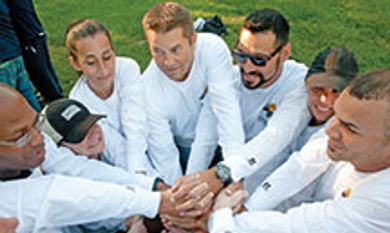 Cooperation has been found
to be a more effective learning
strategy than competition,
and teambuilding activities
focused on working together
tend to offer long-term success,
experts say
Instead of just rewarding those who get good results, an effective exercise would also reward those who help others achieve good results -- discouraging an "every man for himself" dynamic. For example, one type of teambuilding gaining increased popularity as a corporate exercise is an "escape room," which challenges groups with a puzzle that they must solve together within a set amount of time in order to leave a locked room.
"The games are designed for players to use all parts of their brains," says Kimberly Shepherd, sales and marketing director for Escapology, based in Orlando. "The game requires logic and creative thinking. Through the course of playing the game, the participants' skill sets will enable them to emerge as leaders, organizers, creative thinkers, and logical thinkers."
Competing to Win
That's not to say competition or conflict are always bad ideas. Spirited debate or experimentation with different strategies to see what works can be beneficial activities -- as long as the organization lays the proper groundwork for them. Developing an effective teambuilding event begins in the early planning stages. If a planner wants to encourage participation from attendees at the event itself, they will want to encourage participation in the creation of the agenda during the pre-event planning stage. To this end, Dattner recommends getting anonymous input from attendees, from an outside facilitator or through a site like Survey Monkey.
"Anonymity is key, as people may be circumspect about making suggestions because they think it may ruffle feathers or implicitly criticize their colleagues," says Dattner.
Another strategy Dattner recommends is to assign a "Devil's Advocate." This person can argue whatever side may be uncomfortable to discuss -- perhaps that the company is structured poorly, that its strategy is inadequate, or that its competitor's product is better than theirs. The rotating Devil's Advocate can then argue against the group consensus.
Growth Engine's Mattimore gives the example of an event he organized for the board of a large insurance company. They created five teams, each of which role-played five competitors -- "not only obvious industry competitors, but potential industry disruptors as well" such as Amazon and Walmart, he says. Each team developed its "company" strategy and tried to position itself as strongly as possible (with a member of the Amazon team even playing Amazon CEO Jeff Bezos), so that the board could chart how they would take on these competitors.
"Ultimately, the board generated some great growth strategies, and the competitive role playing, team-against-team in the morning -- besides being a lot of fun -- helped build great teams," says Mattimore.
Know Your Audience
Just as teambuilding can fall short when the goals are not in alignment, similar issues come up if the specific audience is not taken into account. Puzzle-solving might be fun for cerebral attendees but could bore those who prefer to be more active. Athletic activities may delight some but send others into a panic.
Alison Green, a management expert who co-authored the book Managing to Change the World, sees this as a major hurdle for teambuilding. "Many people hate them," she says of off-site activities. "They hate them because the company chooses activities that violate people's dignity or privacy, or because something the company intends to be 'fun' is actually miserable for some people."
Green urges planners to give preference to activities that are "voluntary and low-key," keeping in mind that activities that might be fun with friends are not always appropriate in the workplace.
"Teambuilding inherently moves people and teams out of their comfort zones, to seeing themselves and others, and their work process in a new way," says Kate Stockton, president of Philadelphia-based Stockton & Partners Meetings & Events. "The mechanism for creating this 'discomfort,' if you will, requires collaboration between our team and the client to assure the method is the right one."
This requires looking at questions such as the level of physicality attendees would be comfortable with, and what their roles are within the organization. The last thing a planner will want to do is push participants so far outside of their comfort zone that they feel alienated or even embarrassed.
 Lara Steel, Work Life Innovations
"First on the agenda should be establishing ground rules of respectful communication and a 'right to pass' if one doesn't feel comfortable contributing," says Lara Steel, director of Work Life Innovations, based in Australia as well as Jackson, MS. "It's usually good to normalize the idea that they can request a break or leave the room if it's getting a bit heavy or too far out of their comfort zones."
Steel adds that facilitators must be "constantly reading the 'process' of the group" to ensure that participants are feeling engaged and not criticized or left out. Even if blunt honesty is a goal of the event, the facilitator should be clear on how negativity is acceptable and should have a strategy for breaking the tension should things get uncomfortable.
Of course, even the best-designed program is not going to solve major organizational problems. If there is a serious communication or morale problem at the company, those need to first be dealt with at the top of the organization. "Those are issues that require management to step in and take action; they can't be fixed with rope-climbing or trust falls," says Green. "And in fact, trying to use teambuilding in those contexts can make the problems worse, because employees quite rightly will be frustrated that they're being asked to spend their time on frivolous activities while the real issues are unaddressed."
Kjerulf agrees. "If a team has real problems, we have to solve those problems in the workplace," he says. "Taking the team out for unrelated activities, however fun they may be, is unlikely to work."
And once the event takes place, it is essential for the leaders to do the proper follow-up. "Many a corporation has spent tens of thousands of dollars on leadership, teambuilding, and retreats where everyone has a great time and enjoys the activities... but then they never speak of it again," says Steel. "Everyone goes back to work on Monday, usually paying dearly for the time out of the office by being hit with a mountain of emails."
Steel says the company must avoid considering the "warm and fuzzy" feeling as the sole sign of a successful teambuilding, as the everyday pressures of work will eventually pull staff back into old habits. Instead, it may be worthwhile to regroup for a "consolidation session" two to four weeks after the initial gathering. "You really need to get internal team members to take on some of the tasks of keeping it front of mind," says Steel. "If there's no follow-up, long-term learning and change is highly unlikely, and therefore there's no ROI."
Questions or comments? Email [email protected]
This article appears in the August 2015 issue of Successful Meetings.