When it comes to good corporate citizenship -- and really, just good citizenship in general -- the conversation has largely moved beyond just the environment. That's not to say that environmental issues are becoming less important, as concerns like climate change and water resources have grown into a major political topic across the country and the globe in the last decade. It's just that other issues like diversity, philanthropy, and being involved in the community your employees live in and work in -- corporate social responsibility -- are becoming part of the same conversation.
"Our viewpoint is that sustainability differs from 'green' in that the term 'green' focuses on environmental conditions," says Bonnie Boisner, vice president, event management, at Minneapolis-based Aimia, a leading meeting and employee engagement firm, "whereas 'sustainability' is a more holistic term, encompassing economic, social, and/or behavioral issues."
Michael Dominguez, senior vice president and chief sales officer of MGM Resorts International, one of the world's leading casino-resort companies, says much the same thing, noting that the understanding of these issues by both the gaming industry and corporate America in general has "matured" in the last five or six years. At that time, he says, "everybody was recycling and that was their part of 'doing well.' Today, we're looking at more comprehensive programs that are less about a marketing campaign and very much more about sustainability, over the long term.
"When we talk about corporate social responsibility [CSR], it is [the environment] and it is philanthropy and it is diversity. In our company, we have a major focus on all three of those. I don't think you could separate them today."
Put Your Money Where Your Mouth Is
That growing focus on CSR is true for much of corporate America as well, Dominguez says. "It is important that when they take meetings off site, that they're working with companies that show the same values or at least share the same intensity and focus on sustainability."
How often this happens in practice is debatable, though. "From a meeting and events perspective, we have not had many groups stress the importance of green meetings, although we do mention our Green Lodging designation," says Mark Tascione, director of sales and catering at the Seminole Hard Rock Hotel & Casino in Hollywood, FL, between Miami and Fort Lauderdale, referring to the property's Two Palm rating from Florida's Green Lodging program.
Nor is it just an American phenomenon. "I wish more people were asking, but it is just not a decision-making factor," says Cindy Hoddeson, director of meeting and incentive sales for the Monaco Government Tourist Office. For one thing, the only other destination as well known for its casino resorts as Las Vegas takes environmental issues very seriously and invests a great deal of money and effort in them, and this focus starts at the top. "Our environment is one of the hot buttons with HSH Prince Albert II, and this trickles down to daily life in the principality," says Hoddeson.
Aimia's Boisner tells a different story, however, saying that the sustainability efforts by potential meetings venues are an effective selling point to both third-party planning companies like Aimia and corporate clients.
"More and more organizations are looking closely at the impact they have on the environment," Boisner says. "This includes making good choices to do business with organizations that have common sustaina-bility goals. Meetings and events provide an exceptional opportunity to showcase among attendees your organization's commitment to sustainability."
Dominguez, who served as chairman of Meeting Professionals International for the 18 months ending in January, has a slightly different perspective on how important sustainability is to corporate clients.
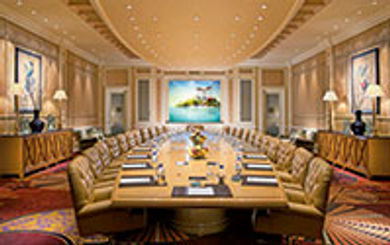 Gaming properties like the Mirage
in Las Vegas work to help meeting
clients demonstrate their
commitment to sustainability
"The research we've seen in this market is it's important to [planners and corporations], but you also see in those same surveys that it's not a deal breaker," he says.
That said, Dominguez adds that the improving economy has created a seller's market for hotels, so with planners facing higher prices and difficulty finding available space, the environment may be taking a back seat for now.
"The planners have to have their meetings, so their choices might be limited," he says. "If they have the choice, they are going to try to partner with somebody that is working to preserve the environment."
Community and Diversity
More than occasionally, some people feel that gambling has a negative impact on communities, which is likely one of the reasons gaming companies want to be seen as good neighbors. It's hardly the only one, of course. For one thing, casino resorts tend to have a large number of employees and a substantial interest in employee engagement, and thus spend a lot of time, effort, and money on loyalty initiatives. And supporting the local community and other types of CSR programs is an important part of these corporate loyalty initiatives.
"Sustainability and our philanthropy efforts is something that's really important to us," Dominguez says. "But our team members are passionate about this, and they do take kind of a lead, so we listen to them and want their input because they're driving a lot of it for their own communities."
He adds, "The funny thing is, I don't know if it's as much us trying to get the employees [involved in the community] or being driven by our employees expecting us to do this for our community."
That passion can be even more intense in the company's properties outside of Las Vegas, like the Beau Rivage in Biloxi, MS, and MGM Grand in Detroit, Dominguez says. "I think [that's] because they're smaller communities and we have lots of resources, so we tend to take a leadership role on those type of efforts," he says, adding that it's also good for business. A large part of the reason MGM Resorts was awarded the competitive casino licenses for the $800 million resort it is building in Springfield, MA, and the $1.3 billion property in National Harbor, MD, "is because those communities are so impressed with what we do for the community and what we do from a sustainability standpoint," he says.
At each Caesars Entertainment property in and out of Nevada there is a HERO volunteer coordinator, as part of the company's Code Green sustainability initiative. In 2014, the company's employees volunteered nearly 200,000 hours in the communities they work in, while the organization donated $74 million. And aside from the broad diversity-in-hiring program that the major Las Vegas Strip resorts share, Caesars Entertainment launched the Caesars Enlisting Heroes program in 2013, hiring more than 2,000 armed forces veterans and donating more than $1 million to veterans' organizations.
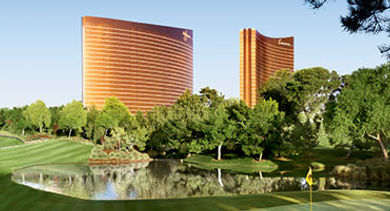
Of course diversity encompasses many groups, from women to immigrants and many others in between. At the five-star Wynn Las Vegas & Encore Resort on The Strip, the "commitment to diversity is among the strongest of any gaming company in the U.S.," says Meghan Speranzo, a spokesperson, noting that the two properties have perfect scores on the Human Rights Campaign Foundation's 2014 Corporate Equality Index, measuring LGBT workplace equality. "We are a company that recognizes that cultural diversity goes beyond language, ethnicity, race, religion, gender, sexual orientation, range of ability, and age. We believe that amazing things happen when people from different world views work with each other toward a common goal."
The two resorts spend $635,000 weekly on goods and services purchased from more than 200 minority-, women-, and veteran-owned businesses, she adds. Nearly two-thirds of the workforce and a third of the executives are minorities, while one third are women, as are nearly half the executives.
The Environment
While sustainability is larger than the environment, green issues are still the largest part of sustainability. In part, this goes back to the "good neighbor" commitment of gaming resorts, but also because when done right, environmental policies can be money-savers.
Aimia's Boisner says many sustainable options available to meeting and event planners are often "less expensive than the alternative."
She adds, "Aimia has identified five simple ways to reduce your carbon footprint through environmentally sustainable practices." These are:
1. Efficient transportation practices, such as encouraging the use of public transportation within a certain radius of the event.
2. Using biodegradable serviceware.
3. Reducing paper and collateral materials by using mobile apps and event websites for communications.
4. Using water-cooler stations rather than bottled water.
5. Sourcing local goods to reduce transportation emissions.
Both the Wynn Las Vegas and Encore buildings are LEED (Leadership in Energy and Environmental Design) Gold-certified by the U.S. Green Building Council. Among the benefits are a reduction in energy use of 18 million kilowatts per year -- enough to power more than 1,600 homes -- and the attendant reduction in the energy bill. And just the five acres of artificial turf in the resort -- not even including other things like low-flow fixtures -- saves 15 million gallons of water a year, which is no small thing in a desert with growing water-shortage con-cerns. At MGM, Dominguez notes that the company recently completed a 20-acre solar roof on the Mandalay Convention Center, which will provide a quarter of its power and eventually pay for itself. The company also invested about $8.75 million recently for special pumps that help make its Las Vegas properties' water-based cooling systems more efficient.
The Seminole Hard Rock Hotel & Casino, which has a Two Palm designation from Florida's Green Lodging program, is very near the Everglades, a critical and endangered part of Florida's natural environ-ment. Its commitment to protecting that natural resource goes a lot farther then publicity. "The Everglades environment is critically important to the members of the Seminole Tribe of Florida, which owns and operates the [property], says Gary Bitner, spokesperson for the tribe. "Two of the tribe's reservations are located in or near the Everglades, so issues of water quality and availability, as well as the threat of sea-level rise, directly impact Everglades life. Members … are intent on preserving the land and water where they live, much as their ancestors have done for centuries."
MGM Resorts' City Center project in Las Vegas, which was designed from the ground up to be environmentally friendly, has six LEED Gold certifications. Its Beau Rivage Resort & Casino, in Biloxi, was one of the first two Mississippi resorts to be awarded a 4 Green Key rating by the Green Key Eco-Rating Program. MGM Resorts also has a fleet of alternate-fuel and hybrid vehicles, as well as 1,400 vehicle charging stations. At Caesars Entertainment, the Code Green project has seen the company cut greenhouse gas emissions by 10 percent since 2007, and is on track to achieve a 40 percent reduction by 2025.
And in Monaco, Hoddeson says, "The Prince Albert II Foundation has three main areas of focus: climate change, biodiversity, and ensuring potable water is available to people." The public transportation system is entirely powered by hybrid, biofuel, and electric vehicles, and there are no plastic bags in the principality.
"Much of what is done is not visible to the visitor," she adds. "Initiatives taken by the Grimaldi Forum Monaco and our hotels -- like waste management and environmentally friendly cleaning products are not sexy. But they do matter."
Questions or comments? Email [email protected]
This article appears in the April 2016 issue of Successful Meetings.
Community and Diversity
More than occasionally, some people feel that gambling has a negative impact on communities, which is likely one of the reasons gaming companies want to be seen as good neighbors. It's hardly the only one, of course. For one thing, casino resorts tend to have a large number of employees and a substantial interest in employee engagement, and thus spend a lot of time, effort, and money on loyalty initiatives. And supporting the local community and other types of CSR programs is an important part of these corporate loyalty initiatives.
"Sustainability and our philanthropy efforts is something that's really important to us," Dominguez says. "But our team members are passionate about this, and they do take kind of a lead, so we listen to them and want their input because they're driving a lot of it for their own communities."
He adds, "The funny thing is, I don't know if it's as much us trying to get the employees [involved in the community] or being driven by our employees expecting us to do this for our community."
That passion can be even more intense in the company's properties outside of Las Vegas, like the Beau Rivage in Biloxi, MS, and MGM Grand in Detroit, Dominguez says. "I think [that's] because they're smaller communities and we have lots of resources, so we tend to take a leadership role on those type of efforts," he says, adding that it's also good for business. A large part of the reason MGM Resorts was awarded the competitive casino licenses for the $800 million resort it is building in Springfield, MA, and the $1.3 billion property in National Harbor, MD, "is because those communities are so impressed with what we do for the community and what we do from a sustainability standpoint," he says.
 Caesars Entertainment asks planners
to donate unused conference supplies
to local schools
At each Caesars Entertainment property in and out of Nevada there is a HERO volunteer coordinator, as part of the company's Code Green sustainability initiative. In 2014, the company's employees volunteered nearly 200,000 hours in the communities they work in, while the organization donated $74 million. And aside from the broad diversity-in-hiring program that the major Las Vegas Strip resorts share, Caesars Entertainment launched the Caesars Enlisting Heroes program in 2013, hiring more than 2,000 armed forces veterans and donating more than $1 million to veterans' organizations.
Of course diversity encompasses many groups, from women to immigrants and many others in between. At the five-star Wynn Las Vegas & Encore Resort on The Strip, the "commitment to diversity is among the strongest of any gaming company in the U.S.," says Meghan Speranzo, a spokesperson, noting that the two properties have perfect scores on the Human Rights Campaign Foundation's 2014 Corporate Equality Index, measuring LGBT workplace equality. "We are a company that recognizes that cultural diversity goes beyond language, ethnicity, race, religion, gender, sexual orientation, range of ability, and age. We believe that amazing things happen when people from different world views work with each other toward a common goal."
The two resorts spend $635,000 weekly on goods and services purchased from more than 200 minority-, women-, and veteran-owned businesses, she adds. Nearly two-thirds of the workforce and a third of the executives are minorities, while one third are women, as are nearly half the executives.
The Environment
While sustainability is larger than the environment, green issues are still the largest part of sustainability. In part, this goes back to the "good neighbor" commitment of gaming resorts, but also because when done right, environmental policies can be money-savers.
Aimia's Boisner says many sustainable options available to meeting and event planners are often "less expensive than the alternative."
She adds, "Aimia has identified five simple ways to reduce your carbon footprint through environmentally sustainable practices." These are:
1. Efficient transportation practices, such as encouraging the use of public transportation within a certain radius of the event.
2. Using biodegradable serviceware.
3. Reducing paper and collateral materials by using mobile apps and event websites for communications.
4. Using water-cooler stations rather than bottled water.
5. Sourcing local goods to reduce transportation emissions.
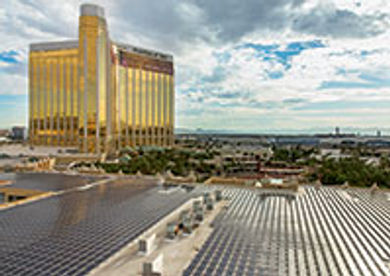 The 2.1-million-square-foot
Manadalay Bay Convention Center's
20-acre roof is now covered in a
huge bank of solar panels, supplying
25 percent of its power needs
Both the Wynn Las Vegas and Encore buildings are LEED (Leadership in Energy and Environmental Design) Gold-certified by the U.S. Green Building Council. Among the benefits are a reduction in energy use of 18 million kilowatts per year -- enough to power more than 1,600 homes -- and the attendant reduction in the energy bill. And just the five acres of artificial turf in the resort -- not even including other things like low-flow fixtures -- saves 15 million gallons of water a year, which is no small thing in a desert with growing water-shortage con-cerns. At MGM, Dominguez notes that the company recently completed a 20-acre solar roof on the Mandalay Convention Center, which will provide a quarter of its power and eventually pay for itself. The company also invested about $8.75 million recently for special pumps that help make its Las Vegas properties' water-based cooling systems more efficient.
The Seminole Hard Rock Hotel & Casino, which has a Two Palm designation from Florida's Green Lodging program, is very near the Everglades, a critical and endangered part of Florida's natural environ-ment. Its commitment to protecting that natural resource goes a lot farther then publicity. "The Everglades environment is critically important to the members of the Seminole Tribe of Florida, which owns and operates the [property], says Gary Bitner, spokesperson for the tribe. "Two of the tribe's reservations are located in or near the Everglades, so issues of water quality and availability, as well as the threat of sea-level rise, directly impact Everglades life. Members … are intent on preserving the land and water where they live, much as their ancestors have done for centuries."
MGM Resorts' City Center project in Las Vegas, which was designed from the ground up to be environmentally friendly, has six LEED Gold certifications. Its Beau Rivage Resort & Casino, in Biloxi, was one of the first two Mississippi resorts to be awarded a 4 Green Key rating by the Green Key Eco-Rating Program. MGM Resorts also has a fleet of alternate-fuel and hybrid vehicles, as well as 1,400 vehicle charging stations. At Caesars Entertainment, the Code Green project has seen the company cut greenhouse gas emissions by 10 percent since 2007, and is on track to achieve a 40 percent reduction by 2025.
And in Monaco, Hoddeson says, "The Prince Albert II Foundation has three main areas of focus: climate change, biodiversity, and ensuring potable water is available to people." The public transportation system is entirely powered by hybrid, biofuel, and electric vehicles, and there are no plastic bags in the principality.
"Much of what is done is not visible to the visitor," she adds. "Initiatives taken by the Grimaldi Forum Monaco and our hotels -- like waste management and environmentally friendly cleaning products are not sexy. But they do matter."
Questions or comments? Email [email protected]
This article appears in the April 2016 issue of Successful Meetings.