For the inaugural year of the Miami New Construction Show, event founder Anita Funtek knew sponsors would be essential to the show's success. But with no prior history, the three-day event, which brought together South Florida-based real-estate buyers and investors and included an extensive education program, was a hard sell -- even with guests that included Florida Gov. Rick Scott.
"For the first year of any show, there can be a lack of confidence from sponsors, and allocating money can be difficult," says Funtek. "I've seen some companies that have a policy where they will not sponsor an event unless it has been in operation for at least five years."
With that in mind, as she reached out to potential sponsors, Funtek avoided promoting specific avenues of revenue. Instead, she created a multi-faceted opportunity that would promote the sponsor, offer value to attendees, and help bolster the nascent conference. She found a partner in Macy's, which wanted to provide support for the event but shied away from "assigning money, which would have had to go through corporate channels for approval," according to Funtek.
Instead, Funtek and the department store chain worked out an arrangement by which Macy's provided gift bags, containing such items as certificates for complimentary facials (for women) and samples of Paco Rabanne cologne (for men), to be given out to attendees. "It enabled the show to start our relationship with our audience off on the right foot. The attendees received items they could use, and it was good exposure for Macy's," says Funtek. "But it came out of having conversations with the company, and being open and flexible about what would work for them and us."
Funtek's experience points to a complex consideration for meeting planners: Event sponsorships are a delicate balancing act of competing demands. Focus only on keeping sponsors happy, and the excessive promotional messaging may turn off attendees. Focus only on attendee needs, and opportunities to bring in valuable sponsorship support can fall through the cracks.
As demand for stronger meetings ROI has grown (a recent study from TCG Events found that 75 percent of executives are seeking greater return from corporate events than they have in previous years), meeting professionals are working to get smarter about how they leverage event sponsorships. They are finding it increasingly vital to work closely with their sponsors while also understanding their attendees, designing a creative sponsorship program that will benefit both.
"What planners ought to be doing is selling solutions," says Ron Seaver, founder and president of the San Diego-based Seaver Marketing Group, which specializes in sponsorship sales. For the past 20 years, Seaver has run the National Sports Forum, which brings together more than 1,000 sports business executives to talk sponsorship, marketing, and business development. He emphasizes that effective sponsorships are those that are developed with solutions for all three major event stakeholders -- sponsors, planners, and attendees -- in mind.
Make It Sponsor Friendly
Seaver says that for events today, selling "inventory" (e.g., lanyard, meal, or badge sponsorships) doesn't cut it. Instead, it's a question of "what can the planner create, package, or bundle within their existing program or event that will help the sponsor to accomplish 'X'?"
That "X" can mean very different things to different sponsors. While some companies may be seeking to make key introductions to corporate decision makers, others might want a platform to let prospective customers test out their new products or services. They may be looking to establish themselves as thought leaders in the industry, or just seeking to keep their brand awareness at its current level.
"It's a mistake to assume that every sponsor wants to accomplish the same thing," says Seaver. "So ask good questions -- and listen."
Seaver points to the example of next year's National Sports Forum (NSF). He sought a way to provide long-time sponsor Daktronics (a major electronic signage and scoreboard company) with more bang for its sponsorship buck than a standard logo on a name badge might provide. Daktronics wanted to showcase its new portable scoreboards to attendees, and, as a company offering enterprise products that can run into multiple millions of dollars, it also wanted to be sure that NSF "keeps their brand center stage in front of our audience of senior team and sports property executives," according to Seaver.
So Seaver is literally putting his sponsor center stage -- the main stage of the conference will be transformed into the Daktronics Stage, with sponsor branding and the side screens being replaced by the sponsor's new portable scoreboards (one in HD and one in standard definition to make the difference obvious to audience members). This messaging extends to the event website as well, with a Daktronics-branded scoreboard clock counting down the months and days to the February 2015 event.
This type of sponsorship, tailored perfectly to the sponsor's needs, can only come about through a flexible attitude from planners.
"There is a demand for more customized sponsorship opportunities," notes Cassie Brown, chief experience officer for Charlotte, NC-based TCG Events, which runs numerous events that rely on sponsorship dollars. The bottom line, according to Brown, is "don't ever assume -- be open and first learn what they'd like to see happen and how they'd like to be involved rather than just throwing a package at them."
Make It Planner Friendly
While appealing to sponsors and attendees is essential, ultimately sponsorships should make the planner's job easier as well. In developing support opportunities, planners will want to keep a point made by Seaver in mind: Don't do something just to get it sponsored.
"The goal isn't for sponsorships to create a heavy stream of work for you," Seaver explains, emphasizing that offerings that keep attendees happy generally have the same effect on the sponsors themselves. "It's for you to do what you ought to be doing to service your audience and members -- and getting that sponsored. Companies sponsor because they want access to your audience. The larger your audience, the more they like it."
For example, if a planner creates an e-newsletter because a sponsor is willing to pay for it, this
raison d'etre will show through in the quality of the product and the (lack of) benefit it provides to recipients. On the other hand, if a planner starts a newsletter to provide valuable content to attendees and they respond positively to it with a high number of clicks, then "it's good business," according to Seaver, and that's the time to "go get it sponsored."
Planners may want to consider something that Julie Austin, founder and president of the Creative Innovation Group, calls "micro-sponsorships." As budget cuts put a strain on meeting planners, an additional source of income can be found by tapping sponsors to cover a specific isolated cost for the event in exchange for promotion of their offerings.
One of the most successful areas in which Austin has applied the micro-sponsorship model is in covering the cost of a keynote speaker with a "speaker sponsor." The idea first occurred to her when she was serving as a speaker herself, offering her insights into planning engaging job fairs at an HR conference.
"Usually a keynote speaker gets paid, but often the breakout speakers don't," Austin explains. "So, I started asking meeting planners if I could get my own sponsorship."
More often than not, the planners obliged, as Austin did much of the work tracking down an appropriate sponsor while much of the fee went to covering event costs (with Austin taking a portion for herself). For example, she recently tapped
HR Professionals Magazine to serve as her speaker sponsor. Austin gave away copies of the magazine as well as branded promotional products ahead of her talk (to help drive attendance) and at the breakout session itself. She also tweeted about the magazine and posted about it on Facebook and LinkedIn.
"[It] enhanced the magazine's brand recognition and visibility," says Cynthia Thompson, publisher and editor of
HR Professionals Magazine. "What a great idea to provide a way to sponsor speakers for conferences that don't have the budget for speakers."
Austin expects to see this type of "micro-sponsorship" grow. "[There] is going to be more interactivity with the sponsors ... and more sponsorships where speakers get their own sponsors and work together to promote them, while still giving great content and avoiding selling from the stage," she says.
In all these sponsorship decisions, flexibility is key. Planners will want to approach both attendees and sponsors with an open mind and a willingness to experiment and change direction when it is mutually beneficial. Planners may even want to consider non-monetary sponsorship opportunities, such as the Macy's giveaways offered at the Miami New Construction Show.
SmithBucklin's Weil agrees. "Don't try to fit the sponsor into a box," he says. "Try to understand what they're trying to do and create something that maps to that."
Questions or comments? Email [email protected]
This article appears in the October 2014 issue of Successful Meetings. Make It Attendee Friendly
While sponsorships should be designed with the specific needs of sponsors in mind, it is of course also key to create opportunities to meet the needs of attendees.
"Understand your attendees in terms of demographics and what will be important to them," says Brown. "Think about what would make their experience more enjoyable or fill a need."
She gives the example of having portable charging stations with sponsor branding that can provide convenience to attendees. If it's a car sponsor, for example, explore having the car company shuttle and transport attendees from the meeting venue to the parking garage.
Dave Weil, vice president of event services for Chicago-based association management and services company SmithBucklin, agrees that practicality should be king when devising a sponsorship. He recommends working to get sponsors behind the services that improve the attendee's experience -- complimentary transportation, water coolers, or Wi-Fi, for example.
"Every time I'm logging on [as an attendee] I'm understanding who the sponsor is," says Weil. "Anything that can create a higher level of comfort is great to get sponsored."
But Weil adds that effective sponsorships can take a more multi-pronged approach, combining both the fun and practical aspects of a meeting. For example, a sponsor that emphasizes a brand message of power or energy could sponsor a series of charging stations where attendees can connect their phones and laptops, but also give away branded energy bars to drive the message home.
TCG works closely with clients to develop sponsorship opportunities that target attendees in ways that will best make an impact. And Brown finds that a great way to meet sponsors' demands and make their messages stand out is to make the on-site solution interactive and fun.
Brown gives the example of a recent event her company planned for a nonprofit client where a number of elements were turned into effective for sponsorships. TCG provided private cabanas where attendees relaxed, using cabana pillows emblazoned with logos of major sponsors such as Accenture, Microsoft, and Bank of America, delivering their messages in what Brown describes as "a welcoming, relaxed, and more natural environment to foster networking and conversation." Further, an event martini lounge provided signature drinks into which sponsors could incorporate their brand colors.
To help make a sponsor's message fun for attendees, some planners have gone so far as to create an actual game out of it. New York City-based TrivWorks develops customized trivia games for corporate events, meetings, and promotional gatherings. Attendees create teams, which compete against other attendee groups for prizes and bragging rights.
The focus of these competitions is on having fun, with a high-energy host, and questions generally focusing on pop-culture topics. But the organizer can customize virtually every element to help broadcast the themes of not only the event, but of specific sponsors as well.
"TrivWorks always seeks to create a fully immersive brand experience for participants, and we encourage branded signage, logos for flatscreen TVs, napkins, coasters, and so on in as many places as possible," says David Jacobson, owner and founder of TrivWorks, adding that client-branded pens and answer sheets, as well as branded T-shirts for the "grading staff" to wear, are also effective ways to create brand consistency.
Of course, trivia questions themselves can be creatively customized for the goals of the event and its sponsor. "[We] seek to educate and appropriately integrate key sponsor messages, features, capabilities, or facts for the participants to take home," says Jacobson.
He points to a program the company developed last year for Every Day with Rachael Ray, where a gathering of the magazine's advertisers was enhanced with food-themed trivia. The program helped to create a fun, memorable experience for advertisers. It was then expanded and modified to appeal to a consumer audience, with a hundred of the questions printed in the magazine's April 2013 issue to encourage readers to play at home -- creating another way for the brand to deliver its message through an entertaining channel.
TrivWorks has developed similar programs for brands including The Economist, the Tony Awards, and JDate.
Create an Exchange of Ideas
BlueGrace Logistics, a transportation and logistics firm based in Riverview, FL, recently brought together owners and staff of the company's franchise network for its Annual Franchise Conference. While this was the event's fourth year, it was the first time BlueGrace offered sponsorships. It became clear that the greatest benefit would come from offering franchise owners and sponsors alike a "360-degree view of each others' businesses," according to Natalie Lane, director of marketing for BlueGrace, who planned the event.
To facilitate this, Lane and her team created Sponsorship Social, a two-hour event that got both attendees and sponsors together at the end of the shwo's second day in a conference room in The Cosmopolitan Las Vegas, where the gathering took place.
"Sponsors had decorative booths and tables set up with promotional items that gave the room the energy you would find on an actual trade-show floor," says Lane.
The social was a huge success, resulting in a room full of lively conversations, and the Franchise Conference earned a 9.55 out of 10 on the post-event Net Promoter Score Survey.
Bobbie Carlton, president of Carlton PR and Marketing, based in Woburn, MA, has taken this networking between sponsors and attendees a step further with her launch five years ago of Mass Innovation Nights. The monthly product-launch party is funded entirely by sponsors, who pay to have their offerings showcased at the events, where social media-savvy attendees can try them out, chat with the sponsors, and tweet, post, or blog about them. On a recent Innovation Night, American Airlines gave away points to its Business Extra program.
"We work very closely with our sponsors to incorporate their programs into ours," says Carlton.
Make It Attendee Friendly
While sponsorships should be designed with the specific needs of sponsors in mind, it is of course also key to create opportunities to meet the needs of attendees.
"Understand your attendees in terms of demographics and what will be important to them," says Brown. "Think about what would make their experience more enjoyable or fill a need."
She gives the example of having portable charging stations with sponsor branding that can provide convenience to attendees. If it's a car sponsor, for example, explore having the car company shuttle and transport attendees from the meeting venue to the parking garage.
Dave Weil, vice president of event services for Chicago-based association management and services company SmithBucklin, agrees that practicality should be king when devising a sponsorship. He recommends working to get sponsors behind the services that improve the attendee's experience -- complimentary transportation, water coolers, or Wi-Fi, for example.
"Every time I'm logging on [as an attendee] I'm understanding who the sponsor is," says Weil. "Anything that can create a higher level of comfort is great to get sponsored."
But Weil adds that effective sponsorships can take a more multi-pronged approach, combining both the fun and practical aspects of a meeting. For example, a sponsor that emphasizes a brand message of power or energy could sponsor a series of charging stations where attendees can connect their phones and laptops, but also give away branded energy bars to drive the message home.
TCG works closely with clients to develop sponsorship opportunities that target attendees in ways that will best make an impact. And Brown finds that a great way to meet sponsors' demands and make their messages stand out is to make the on-site solution interactive and fun.
Brown gives the example of a recent event her company planned for a nonprofit client where a number of elements were turned into effective for sponsorships. TCG provided private cabanas where attendees relaxed, using cabana pillows emblazoned with logos of major sponsors such as Accenture, Microsoft, and Bank of America, delivering their messages in what Brown describes as "a welcoming, relaxed, and more natural environment to foster networking and conversation." Further, an event martini lounge provided signature drinks into which sponsors could incorporate their brand colors.
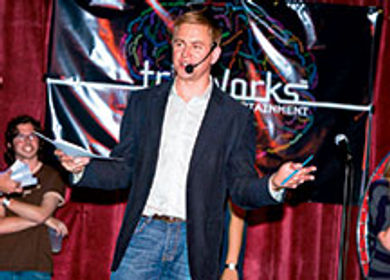 TrivWorks creates customized
trivia games for sponsors -- delivering
corporate messages in an entertaining way
To help make a sponsor's message fun for attendees, some planners have gone so far as to create an actual game out of it. New York City-based TrivWorks develops customized trivia games for corporate events, meetings, and promotional gatherings. Attendees create teams, which compete against other attendee groups for prizes and bragging rights.
The focus of these competitions is on having fun, with a high-energy host, and questions generally focusing on pop-culture topics. But the organizer can customize virtually every element to help broadcast the themes of not only the event, but of specific sponsors as well.
"TrivWorks always seeks to create a fully immersive brand experience for participants, and we encourage branded signage, logos for flatscreen TVs, napkins, coasters, and so on in as many places as possible," says David Jacobson, owner and founder of TrivWorks, adding that client-branded pens and answer sheets, as well as branded T-shirts for the "grading staff" to wear, are also effective ways to create brand consistency.
Of course, trivia questions themselves can be creatively customized for the goals of the event and its sponsor. "[We] seek to educate and appropriately integrate key sponsor messages, features, capabilities, or facts for the participants to take home," says Jacobson.
He points to a program the company developed last year for Every Day with Rachael Ray, where a gathering of the magazine's advertisers was enhanced with food-themed trivia. The program helped to create a fun, memorable experience for advertisers. It was then expanded and modified to appeal to a consumer audience, with a hundred of the questions printed in the magazine's April 2013 issue to encourage readers to play at home -- creating another way for the brand to deliver its message through an entertaining channel.
TrivWorks has developed similar programs for brands including The Economist, the Tony Awards, and JDate.
Make It Planner Friendly
While appealing to sponsors and attendees is essential, ultimately sponsorships should make the planner's job easier as well. In developing support opportunities, planners will want to keep a point made by Seaver in mind: Don't do something just to get it sponsored.
"The goal isn't for sponsorships to create a heavy stream of work for you," Seaver explains, emphasizing that offerings that keep attendees happy generally have the same effect on the sponsors themselves. "It's for you to do what you ought to be doing to service your audience and members -- and getting that sponsored. Companies sponsor because they want access to your audience. The larger your audience, the more they like it."
For example, if a planner creates an e-newsletter because a sponsor is willing to pay for it, this
raison d'etre will show through in the quality of the product and the (lack of) benefit it provides to recipients. On the other hand, if a planner starts a newsletter to provide valuable content to attendees and they respond positively to it with a high number of clicks, then "it's good business," according to Seaver, and that's the time to "go get it sponsored."
Planners may want to consider something that Julie Austin, founder and president of the Creative Innovation Group, calls "micro-sponsorships." As budget cuts put a strain on meeting planners, an additional source of income can be found by tapping sponsors to cover a specific isolated cost for the event in exchange for promotion of their offerings.
One of the most successful areas in which Austin has applied the micro-sponsorship model is in covering the cost of a keynote speaker with a "speaker sponsor." The idea first occurred to her when she was serving as a speaker herself, offering her insights into planning engaging job fairs at an HR conference.
"Usually a keynote speaker gets paid, but often the breakout speakers don't," Austin explains. "So, I started asking meeting planners if I could get my own sponsorship."
More often than not, the planners obliged, as Austin did much of the work tracking down an appropriate sponsor while much of the fee went to covering event costs (with Austin taking a portion for herself). For example, she recently tapped
HR Professionals Magazine to serve as her speaker sponsor. Austin gave away copies of the magazine as well as branded promotional products ahead of her talk (to help drive attendance) and at the breakout session itself. She also tweeted about the magazine and posted about it on Facebook and LinkedIn.
"[It] enhanced the magazine's brand recognition and visibility," says Cynthia Thompson, publisher and editor of
HR Professionals Magazine. "What a great idea to provide a way to sponsor speakers for conferences that don't have the budget for speakers."
Austin expects to see this type of "micro-sponsorship" grow. "[There] is going to be more interactivity with the sponsors ... and more sponsorships where speakers get their own sponsors and work together to promote them, while still giving great content and avoiding selling from the stage," she says.
In all these sponsorship decisions, flexibility is key. Planners will want to approach both attendees and sponsors with an open mind and a willingness to experiment and change direction when it is mutually beneficial. Planners may even want to consider non-monetary sponsorship opportunities, such as the Macy's giveaways offered at the Miami New Construction Show.
SmithBucklin's Weil agrees. "Don't try to fit the sponsor into a box," he says. "Try to understand what they're trying to do and create something that maps to that."
Questions or comments? Email [email protected]
This article appears in the October 2014 issue of Successful Meetings.