In the years following the economic downturn of 2008, incentive travel's slow and steady comeback has finally hit its stride. "I would say that incentive travel is pretty close to being back to pre-downturn levels at this point," says Lynn Randall, managing member of Randall Insights and education consultant for the Incentive Research Foundation (IRF). She points to a recent IRF trends survey showing that incentive travel planners are seeing a more positive impact from the economy. "That economic strength is helping with budgets and planning for incentive programs," says Randall.
As more organizations continue to bring back and invest in their incentive travel programs, the programs themselves are also beginning to evolve, placing a greater emphasis on one-of-a-kind experiences that encompass not just the trip itself but year-long engagement and motivation.
Rhea Stagner, division vice president of supplier relations and sourcing for Maritz Travel, says that the conversation among planners today is focused on creating truly memorable experiences for winners. "It's about what will make the trip feel like a personal experience versus one that's one-size-fits-all," she says.
Tony Wagner, vice president of CWT Meetings & Events, Americas region, agrees that there is now greater demand for unique experiences. But he adds that this effort is connected to planners seeking the greatest return from incentive travel and getting better at "articulating the purpose of the incentive trip" -- an effort that also includes setting compliance policies and codes of ethics.
"It's a part of their sales plan and their growth plan," says Wagner. "For our customers, it's about staying within budget while ensuring a rewarding experience for attendees to drive behavior."
In this push to get greater value from incentive programs, planners are also seeking ways to motivate participants before and after the trip itself. "It's about elongating the experience outside just the incentive travel program operation itself," says Stagner.
Randall points to a recent IRF "Pulse Survey" which found that 52 percent of respondents are moderately increasing their incentive travel budgets to "provide more enhanced experiences." She adds, "The real focus is on the winner's experience that they have on site -- having a very genuine and local experience is important."
Budgets Still Matter
While there's greater emphasis on the overall incentive travel experience, budgets are still a deciding factor for many programs. As airfares and hotel rates continue to climb, increasing cost and decreasing hotel availability are impacting programs' bottom lines.
"Budgets are still a major consideration," says Marty Doyle, director of travel experiences for incentive firm Dittman Incentive Marketing, based in New Brunswick, NJ. "We monitor these trends in airline and hotel pricing/availability, and work closely with our clients to be sure that they are aware of the changing environment and can plan their programs and manage their budgets accordingly."
"Cost is definitely a factor for today's incentive travel programs," adds Randall. "Organizations have to look at how many room nights they want to load into the program plan because rates are higher than they have been in recent years. The air cost has driven up so high at this point that the air travel component is also significantly affecting the way people plan, put together their budgets, and do their programs."
Randall says that the most recent IRF Pulse Survey shows that travel budgets are "stabilizing" and respondents are spending their money on "non-F&B related items." "They're adding more experiential elements to their programs," she notes.
All In
All-inclusive resorts, like cruises, are also becoming a popular incentive travel program choice. About 16 percent of IRF study participants said they are moving to all-inclusive destinations, according to IRF's Randall. Much like cruises, today's all-inclusive resorts have evolved to offer more luxurious, upscale experiences and value.
Maritz's Stagner has seen an uptick in all-inclusive resorts as well, thanks in part to the rise in high-end offerings from a number of brands. "You really have these stepped-up opportunities in Cancun and Puerto Vallarta, and many of our customers see them as really great values where they can get a lot more for their money. That's why these destinations and properties are so popular," she says.
The popularity of all-inclusive properties is also attracting hotel brands. This year, Hyatt Hotels & Resorts, in partnership with Playa Hotels & Resorts, debuted its Hyatt Ziva and Hyatt Zilara all-inclusive brands in Mexico, and it will introduce them later this year, in Jamaica.
Part of the equation for planners looking to boost incentive ROI is to incorporate business into the fun. Randall points out that the IRF conducted a meetings incentive group travel integration study last year in which they found a 50/50 split in the number of planners who incorporate a meeting into an incentive trip and the number of planners who do not.
"The differentiator is the culture of the organization," says Randall. Also key: "Making that meeting experience something that enhances the participants' job or personal life so that it really makes that a benefit to them versus anyone else who might have not earned the trip."
Questions or comments? Email [email protected]
This article appears in the October 2014 issue of Successful Meetings.
Not One-Size-Fits-All
Those experiential elements are being offered in a variety of different ways, tailored to different groups and preferences. "We're seeing more multiple activity tracks for the same incentive travel program," says Wagner. "It really appeals to multiple generations."
Wagner says that this year one of his clients held two separate incentive travel programs to reward winners -- a Disney cruise that would include families, and a trip to Orlando for couples only. For the family-friendly program, each winner could bring up to three guests and he or she could pay to bring a fourth person. Wagner believes that the success of this year's dual incentive travel programs convinced his client to offer the same two trip options next year as well.
"I think you'll continue to see programs offering multiple tracks of activities and really customizing the activities and experiences for the participants," says Wagner. "You'll see different tracks of activities that we need to weave into incentives now to account for all the varying expectations from winners." For example, golf is more popular with Boomers and Gen Xers; Millennials aren't necessarily as excited by golf but they might be into hiking or mountain biking.
As for other customization options, Randall suspects that Millennials are also driving a trend toward wellness travel, giving attendees a chance to improve their health while enjoying an exotic destination. She also sees culinary tourism continuing to have an impact on the types of activities included in incentive itineraries.
Crossing Borders
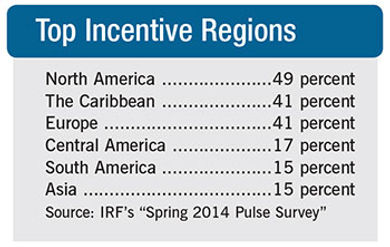
This year also saw a slight uptick in international incentive travel programs. Slightly more respondents to the IRF's Pulse Survey plan to shift from domestic to international programs, according to Randall.
"In general, I would say that the world is wide open to our clients," says Kate Rice, senior travel buyer for The Performance Group, an incentive and corporate event planning company based in California's Bay Area. "I'm a strong believer in incentives, and as companies become more global, they need to bring everyone together through incentives."
One type of incentive travel program that is picking up steam is cruising. A new era of world-class vessels and expanded, global itineraries are making cruising an attractive option for incentive trips. With an abundance of choices in dining, entertainment, and activities, as well as opportunities for cost savings, cruising has become an even more in-demand incentive travel option. A November 2013 Site Index study in cooperation with Cruise Lines International Association found that 88.8 percent of respondents would recommend a cruise ship for a motivational group incentive travel program. Seventy-six percent of respondents said they were planning an incentive group travel program on a cruise between 2014 and 2016.
"It's a whole new world, and a whole different experience on today's cruises," says Jo Kling, co-founder of Miami-based Landry & Kling, a MICE cruise specialty firm. Kling says that more flexible dining options, entertainment offerings, and diversity in destinations are making cruises particularly fitting for incentive groups. "There's really a ship out there for every type of group, whether you are looking for luxury, intimacy, or a wide variety of attractions."
Lori Cassidy, director of corporate, incentive, and charter sales for Royal Caribbean International, reports double-digit growth for "probably six consecutive years. I think planners are realizing that cruise ships today are very different from cruise ships in the '70s and '80s. The hardware that we bring to the table is incredible, very innovative," she says. "We are thinking about business more so than just the vacationing public when we're building our hardware today. I think you're going to start seeing that uptick in incentive business increase even further in the future."
The all-inclusiveness of cruises, as well as more intimate, personalized experiences, are also appealing draws for incentive groups. Lines such as Regent Seven Seas Cruises and Oceania Cruises, for example, offer a variety of complimentary amenities, from free shore excursions and unlimited Internet access to gourmet dining and airport transfers.
"Most of our clients tend to sail with Regent Seven Seas where there are 600 passengers or less on each ship," says Rice. "It's a different type of experience whereby you can see a lot of destinations, but also feel like you have the freedom to do so much more than you would with just a standalone hotel."
Both Rice and Tina Weede, president of USMotivation, have also noted the popularity of Mediterranean cruises. Weede has also seen increased demand for Baltic cruises. River cruising, notes Weede and Stagner, is also making a comeback.
All In
All-inclusive resorts, like cruises, are also becoming a popular incentive travel program choice. About 16 percent of IRF study participants said they are moving to all-inclusive destinations, according to IRF's Randall. Much like cruises, today's all-inclusive resorts have evolved to offer more luxurious, upscale experiences and value.
Maritz's Stagner has seen an uptick in all-inclusive resorts as well, thanks in part to the rise in high-end offerings from a number of brands. "You really have these stepped-up opportunities in Cancun and Puerto Vallarta, and many of our customers see them as really great values where they can get a lot more for their money. That's why these destinations and properties are so popular," she says.
The popularity of all-inclusive properties is also attracting hotel brands. This year, Hyatt Hotels & Resorts, in partnership with Playa Hotels & Resorts, debuted its Hyatt Ziva and Hyatt Zilara all-inclusive brands in Mexico, and it will introduce them later this year, in Jamaica.
Part of the equation for planners looking to boost incentive ROI is to incorporate business into the fun. Randall points out that the IRF conducted a meetings incentive group travel integration study last year in which they found a 50/50 split in the number of planners who incorporate a meeting into an incentive trip and the number of planners who do not.
"The differentiator is the culture of the organization," says Randall. Also key: "Making that meeting experience something that enhances the participants' job or personal life so that it really makes that a benefit to them versus anyone else who might have not earned the trip."
Questions or comments? Email [email protected]
This article appears in the October 2014 issue of Successful Meetings.