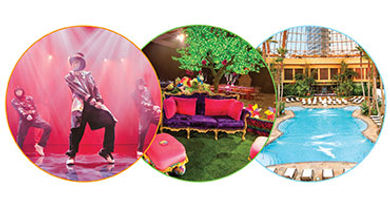
Despite the fact that Millennials find gambling less appealing than do their Generation X and Baby Boomer predecessors, gaming destinations and properties large and small remain universally appealing. That's due to properties' ability to constantly transform and expand their offerings to include fine dining, entertainment, and other experiences that go far beyond rolling the dice or dealing the cards.
"Gaming resorts and destinations are the ideal locations for holding meetings or incentives because they appeal to every demographic and generation under one roof," says Hillary Bamont, sales director at Kansas City, MO--based meeting planning firm Bishop-McCann. "We always try to book programs based on demographic or generational needs. In the case of a gaming destination, it's almost always a slam dunk because there is something for everybody."
In Las Vegas, she points out that Strip hotels have mastered the art of pleasing everybody in one location. Giving the example of a 5,000-person sales conference, "The 23-year-old sales rep can enjoy a night of clubbing," while a 50-year-old sales rep can catch one of the many Cirque du Soleil shows or head to the spa for a massage.
Matthew Marcial, CAE, CMP, vice president of education and events for Meeting Professionals International (MPI), helped take his organization's World Education Congress to Atlantic City, NJ, in 2016. He shares Bamont's opinion of the suitability of gaming resorts for mixed groups and adds, "These destinations pride themselves on being able to offer something for everyone, even those who have no interest in gaming." He notes that as for any meeting or event, "you need to have a good understanding of your attendee base when deciding on the best fit for the host venue. Understanding the interests and demographic makeup of your attendees is just a part of that process."
Larger gaming resorts also have enough dining and entertainment options to allow groups to stay on property as opposed to busing them off-site, Bamont notes: "Many groups, after being in a meeting room for eight hours, prefer this option, and it saves our clients on transportation costs as well."
Deal Out the Millennials
"At resorts in the Caribbean, or on cruise ships with casinos, it's the island, it's the sun, it's the activities," says Mike May, president of incentive and meeting planning firm Spear One, in Irving, TX. "Gambling becomes number four or five on the list."
Wendy Blaney, chief sales officer of the Atlantis, Paradise Island resort in the Bahamas, agrees that resorts like hers are far less focused on -- or known for -- gambling than Las Vegas. "It's one of the many activities that someone could participate in," at Atlantis, she says. "I don't know that any of that really changes if you are 27, 37, or 47."
What has changed is the degree of interest in gambling exhibited by Millennials. Pointing to comments from several of his Millennial employees, May says, "they will do a little gambling, but they'll do that for an hour." The sentiment, he adds, is, "'Okay, we're in Vegas, we've got to do that,' but then they're ready to move on to experiences," like clubs, restaurants, or off-property activities ranging from hiking to the 550-foot-tall LINQ observation wheel.
This is backed up by research. In a study of Millennials' entertainment preferences released last year by Galloway, NJ--based Stockton University's Lloyd D. Levenson Institute of Gaming, Hospitality & Tourism, non-Millennials were twice as likely to rate gambling as an important activity as Millennials -- 42 percent to 21 percent, respectively. That said, when it comes to table games like blackjack, roulette, and craps, the percentage of Millennials surveyed who play them (57 percent) was nearly identical to non-Millennials (58 percent). But, Millennials going to gaming resorts reported spending just 8.5 percent of their budget on gambling, compared to 23.5 percent for non-Millennials.
That influences how gaming properties market their offerings, says Sarah Moore, executive director of brand and retail for the new MGM National Harbor on the Potomac River near Washington, D.C.
"Gaming customers tend to be an older demographic -- Baby Boomers and Generation X," she says. "We target them through specific promotions, we speak to them directly through the database." For Millennials, she adds, "it's all about the non-gaming amenities -- our incredible hotel, our food and beverage, and our theater."
Of course, none of that means that gambling is not important to a sun-and-fun Bahamian resort like Atlantis, Blaney says. "But what type of games are in a casino is important as well, because different demographics require different games."
Again, Stockton University's research backs this up. While 44 percent of Millennials reported playing slots, nearly three-quarters of the over-35 respondents -- 72 percent -- play them. But, Millennials prefer to play with family and friends, while the older group likes to play alone. And while the top three table games for both demographics are black jack, roulette, and poker, twice as many Millennials play electronic table games as older generations (28 percent to 14 percent).
Questions or comments? Email [email protected]
This article appears in the August 2017 issue of Successful Meetings.
Playing Without Cards
Despite the presence of massive casino floors, gambling is no longer the main attraction of many casino resorts, whether they are 5,700-room giants like the MGM Grand in Las Vegas or 500-room resorts next to an outdoor paradise like Harrah's Lake Tahoe, according to Michael Dominguez, chief sales officer of MGM Resorts International.
"You'll have people that won't gamble very much when they're here, but they're going to spend the same amount of money they used to spend," Dominguez says. "Now it's in a nightclub or day club for that type of experience -- we have some of the top electronic DJs in the world, some of the top dining you're going to find anywhere in the country. Here's where the younger audience comes in to play."
That's a change the major casino resorts have all made, says Marcial. "They've done a good job of becoming an entertainment destination, a dining destination, an activity destination, especially when you think about all the different headline acts. If you want country, there's a country star there. If you want current pop music, there's going to be some pop music performer there over the weekend. If you want a comedian, there's Jerry Seinfeld or someone like him."
One of Las Vegas' biggest strengths is that the entertainment comes in so many different varieties, Dominguez says, adding that this applies just as much to other gaming destinations. "We have to be able to deliver that type of entertainment to a variety of audiences and a variety of tastes," Dominguez notes. "[We can see] Bruno Mars at the T-Mobile Arena, but we can also go watch Jabbawockeez at MGM Grand."
Caesars Entertainment's funkier, younger-leaning Planet Hollywood Las Vegas Resort and Casino exemplified this trend in July, when both Pit Bull and Ringo Starr performed. The same thing applies outside of Las Vegas. Resorts Casino Hotel in Atlantic City recently became the first hotel in the city to offer daily fantasy sports contests for money online, said a spokesperson, who called it "an effort to attract the younger gambler who is comfortable playing games on a cell phone, tablet, or laptop computer."
And the property's year-round, on-the-beach LandShark Bar & Grill -- part of its all-generations, $35 million Jimmy Buffet's Margaritaville Entertainment Complex -- offers May-to-September cabanas and bottle service that is particularly attractive to Millennials.
In Mashantucket, CT, Foxwoods Resort Casino has brought top DJs like Steve Aoki to its SHRINE nightclub; opened King Ink by celebrity tattoo artist Mario Barth, whose clients range from Usher to Sylvester Stallone; and is debuting the Foxwoods HighFlyer, a 33-story, 60-mile-per-hour zipline, later this year. And last month, it opened the PLAY Arena @ Foxwoods, which offers players an electronic play station for all of their casino games in what it calls "an immersive, multisensory environment" -- think video screens, bright lights, music by a DJ, dancers -- that is very much a Millennial-themed environment unlike a traditional casino floor.
The Other Las Vegas
You don't have to leave Las Vegas to get a smaller and more intimate experience at a gaming property, says Nathan Kontny, CEO of Highrise, a tech firm with a CRM solution and a seven-person staff of four Millennials and three Gen Xers. Twice a year, they gather in Las Vegas for a four-day meet-up.
"The traditional Vegas experience is to put everyone in a fancy hotel on the Strip," he says. "Instead, we stayed in Downtown Vegas, in the Gold Spike, a now non-gaming hotel that Zappos founder Tony Hsieh bought and renovated as part of his effort to revitalize the Downtown area."
The Downtown location was close enough to the "traditional lights and slots and gaming of Vegas to partake in those activities if you wanted to," he says, adding that they also "weren't so close to make you feel inundated by it."
The group spent most of its non-work time together, going to the Strip for dinner at the Venetian followed by a Cirque du Soleil performance of Love at the Mirage, Kontny says, adding, "one night we had drinks by the fancy waterfall at the Wynn Las Vegas."
The rest of the free time was spent Downtown, touring Zappos, hanging out in Hsieh's Container Park, and eating in area restaurants like a Thai place featured on Anthony Bourdain's Parts Unknown, Kontny says.
"The Downtown location is much more affordable -- not just for us as a company, but for our employees who want to get coffee or do anything as part of their time together," Kontny says, adding, "I'd recommend anyone planning a Vegas event give the new Downtown area a look."
Playing Without Cards
Despite the presence of massive casino floors, gambling is no longer the main attraction of many casino resorts, whether they are 5,700-room giants like the MGM Grand in Las Vegas or 500-room resorts next to an outdoor paradise like Harrah's Lake Tahoe, according to Michael Dominguez, chief sales officer of MGM Resorts International.
"You'll have people that won't gamble very much when they're here, but they're going to spend the same amount of money they used to spend," Dominguez says. "Now it's in a nightclub or day club for that type of experience -- we have some of the top electronic DJs in the world, some of the top dining you're going to find anywhere in the country. Here's where the younger audience comes in to play."
That's a change the major casino resorts have all made, says Marcial. "They've done a good job of becoming an entertainment destination, a dining destination, an activity destination, especially when you think about all the different headline acts. If you want country, there's a country star there. If you want current pop music, there's going to be some pop music performer there over the weekend. If you want a comedian, there's Jerry Seinfeld or someone like him."
One of Las Vegas' biggest strengths is that the entertainment comes in so many different varieties, Dominguez says, adding that this applies just as much to other gaming destinations. "We have to be able to deliver that type of entertainment to a variety of audiences and a variety of tastes," Dominguez notes. "[We can see] Bruno Mars at the T-Mobile Arena, but we can also go watch Jabbawockeez at MGM Grand."
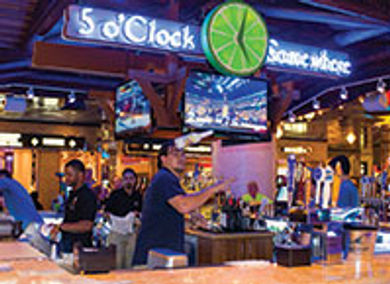 Resorts Casino Hotel in
Atlantic City's new 5 o'Clock
Somewhere Bar
Resorts Casino Hotel in
Atlantic City's new 5 o'Clock
Somewhere BarCaesars Entertainment's funkier, younger-leaning Planet Hollywood Las Vegas Resort and Casino exemplified this trend in July, when both Pit Bull and Ringo Starr performed. The same thing applies outside of Las Vegas. Resorts Casino Hotel in Atlantic City recently became the first hotel in the city to offer daily fantasy sports contests for money online, said a spokesperson, who called it "an effort to attract the younger gambler who is comfortable playing games on a cell phone, tablet, or laptop computer."
And the property's year-round, on-the-beach LandShark Bar & Grill -- part of its all-generations, $35 million Jimmy Buffet's Margaritaville Entertainment Complex -- offers May-to-September cabanas and bottle service that is particularly attractive to Millennials.
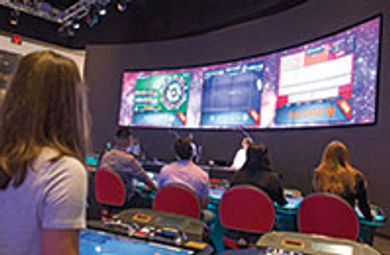 The new PLAY Arena @ Foxwoods
In Mashantucket, CT, Foxwoods Resort Casino has brought top DJs like Steve Aoki to its SHRINE nightclub; opened King Ink by celebrity tattoo artist Mario Barth, whose clients range from Usher to Sylvester Stallone; and is debuting the Foxwoods HighFlyer, a 33-story, 60-mile-per-hour zipline, later this year. And last month, it opened the PLAY Arena @ Foxwoods, which offers players an electronic play station for all of their casino games in what it calls "an immersive, multisensory environment" -- think video screens, bright lights, music by a DJ, dancers -- that is very much a Millennial-themed environment unlike a traditional casino floor.
Do Demographics Matter?
Asked about the differences among Millennials, Generation Xers, and Boomers, Michael Massari, chief sales officer at Caesars Entertainment, says that whether you're talking about meetings, conventions, and events at gaming resorts or non-gaming hotels and facilities, "I don't think there's much of a difference. If you look at the big pillars about why people want to gather together for a face-to-face meeting, I just don't know that there's any difference between the way a Millennial views it, versus the way a Gen Xer views it, versus the way a Baby Boomer views it."
In fact, Massari says he has "come to the conclusion that Millennials as they're traditionally described don't even exist." The real difference, he adds, is what stage of their life they are at -- whether they're married, have children, have bought a house, and where they are in their career. Of course, he adds that he may be "the only guy on the planet that thinks that."
"We say, 'Millennials are willing to quit a job to go to a concert,'" but guess what? I was too when I was 18," Massari admits. "First of all, you're not the president of the company. You've got an entry-level job, and entry-level jobs are a dime a dozen. But the concert's a great concert, and you hate your boss, so you were going to quit anyway. But guess what? Ten years from now, when they're an assistant director or junior vice president, they're not quitting their job to go to a concert. I think the only material difference is that they are starting these things later."
What does change by generation is the type of resort that groups should use, he adds. "It's really important for companies to be very thoughtful about the type of property they're utilizing, and how that interfaces with what they're trying to accomplish."
Caesars' Planet Hollywood "might not be the best match for a conservative financial company from the Northeast, but it's a fantastic match for a technology company from the Bay Area. It still provides great service and has great capabilities, but it's definitely got a vibe to it that's more playful," Massari says. "So, from a company culture standpoint it identifies quite well with technology."
Deal Out the Millennials
"At resorts in the Caribbean, or on cruise ships with casinos, it's the island, it's the sun, it's the activities," says Mike May, president of incentive and meeting planning firm Spear One, in Irving, TX. "Gambling becomes number four or five on the list."
Wendy Blaney, chief sales officer of the Atlantis, Paradise Island resort in the Bahamas, agrees that resorts like hers are far less focused on -- or known for -- gambling than Las Vegas. "It's one of the many activities that someone could participate in," at Atlantis, she says. "I don't know that any of that really changes if you are 27, 37, or 47."
What has changed is the degree of interest in gambling exhibited by Millennials. Pointing to comments from several of his Millennial employees, May says, "they will do a little gambling, but they'll do that for an hour." The sentiment, he adds, is, "'Okay, we're in Vegas, we've got to do that,' but then they're ready to move on to experiences," like clubs, restaurants, or off-property activities ranging from hiking to the 550-foot-tall LINQ observation wheel.
This is backed up by research. In a study of Millennials' entertainment preferences released last year by Galloway, NJ--based Stockton University's Lloyd D. Levenson Institute of Gaming, Hospitality & Tourism, non-Millennials were twice as likely to rate gambling as an important activity as Millennials -- 42 percent to 21 percent, respectively. That said, when it comes to table games like blackjack, roulette, and craps, the percentage of Millennials surveyed who play them (57 percent) was nearly identical to non-Millennials (58 percent). But, Millennials going to gaming resorts reported spending just 8.5 percent of their budget on gambling, compared to 23.5 percent for non-Millennials.
That influences how gaming properties market their offerings, says Sarah Moore, executive director of brand and retail for the new MGM National Harbor on the Potomac River near Washington, D.C.
"Gaming customers tend to be an older demographic -- Baby Boomers and Generation X," she says. "We target them through specific promotions, we speak to them directly through the database." For Millennials, she adds, "it's all about the non-gaming amenities -- our incredible hotel, our food and beverage, and our theater."
Of course, none of that means that gambling is not important to a sun-and-fun Bahamian resort like Atlantis, Blaney says. "But what type of games are in a casino is important as well, because different demographics require different games."
Again, Stockton University's research backs this up. While 44 percent of Millennials reported playing slots, nearly three-quarters of the over-35 respondents -- 72 percent -- play them. But, Millennials prefer to play with family and friends, while the older group likes to play alone. And while the top three table games for both demographics are black jack, roulette, and poker, twice as many Millennials play electronic table games as older generations (28 percent to 14 percent).
Questions or comments? Email [email protected]
This article appears in the August 2017 issue of Successful Meetings.