When it comes to creating not just an event, but also an experience, many of Los Angeles’ top hotels and companies turn to
Susan Manrao. The Los Angeles-based interior designer and self-described experiential design consultant, has worked with more than 148 hotel properties around the world — including W, The St. Regis, and Waldorf Astoria. This year, she led
Beverly Hills’ “Suite 100” project, a multi-property program in which five different Beverly Hills hotels each transformed one of their suites to reflect a different era in the city’s 100-year history.
SuccessfulMeetings.com recently spoke with Manrao to ask her to share some of her event design tips for meeting and incentive planners and here’s what she had to say.
1. Think about your attendees. “The most important thing to think about is understanding who your attendees are and figuring out how to make that meeting or event engaging for them,” she says. “You want to connect with the user so you need to find out what interests them and what they like and then go from there to plan a design aspect that will really engage them.”
2. Pay attention to all five senses. “Whether it’s through music during arrival and departure, a certain type of snack, or a really unique way of serving something as simple as coffee, what affects your senses has a huge impact,” Manrao notes. “I always ask myself how to create something for guests that lets them have an emotional takeaway, and come away feeling engaged and inspired.”
3. Look for spaces that have character, or that can transform easily. “For meetings, especially, I would make it a point to look for spaces that will support what you want. You’re not able to bring in a lot of furniture, or art, or decorative pieces, so you want a space that either has a lot of character already, or something that’s a clean palette where you can do something with big moves, like lighting, or a projector with graphics and logos,” she says. “Creating big moments to make the space feel engaging is key. I really like to focus on creating a table or seating space that will be interesting and intuitive to attendees, too.”
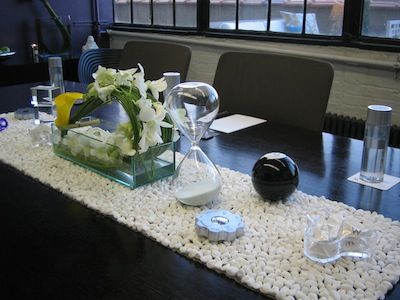
4. Introduce conversation starters. “At a recent press breakfast in New York that promoted Suite 100, I had special View-Masters made where guests could look inside them and see all these great photos of Beverly Hills,” Manrao explains. “At any event, you need to have something that lets people connect with each other. At other events, I’ve even used Rubik’s Cubes or fortune cookies as icebreakers—things that create a sense of discovery and are unexpected. You’re curating what goes on in the area around the guests. Often, people can get bored or antsy, but by having Rubik’s Cubes on the table, or something else that they can take a short mental break with, and engage with, can be helpful. Creating an ambience and atmosphere is difficult to do with furniture and art—they’re not necessarily interacting with that. Even if you don’t have a beautiful space to work with, you can have a big impact by curating what’s on that table.”
5. Branding doesn’t have to be pricey. “At that same Beverly Hills event, we had ‘90210’ waters for example,” she says. “We brought in the branding with something that you’d already have there anyway, so there wasn’t a huge extra cost. You don’t have to spend your budget on extra things. Something that’s tactile and branded will enhance the overall experience and connects to what you’re trying to do with that event.”
6. Pay attention to music. “I think people often underestimate the simplicity of having well-curated music for arrivals, breaks, and departures. I think that’s really important for setting the tone, and music keeps energy up when there’s a break. There’s nothing worse than sitting in a room that’s silent with a bunch of people. It can be so awkward,” Manrao says.
7. Fresh flowers are much appreciated. “I always love having fresh flowers at my events and, if you can’t have fresh flowers, just having something that’s unexpected or colorful makes a huge difference,” Manrao says. “We’re often exposed day in and day out to the same kinds of things, many of which are all monochromatic. When you can bring in color, or even something like pens with an interesting quote on them, or basically anything that brings some life and unexpectedness, it’s really appreciated by attendees.”
8. Don’t be afraid to try something new. “A lot of times when I’ve worked on meetings and events, there’s a budget for everything, and it’s always the same 10 items. You don’t always need those same things,” she says. “Why not switch out flowers for a candy set up? How can you take these things you’re always using and do them differently? When I was at the W, we’d print questions on the drink coasters to start conversations. It engages people and creates fun and whimsy, but you’re not adding another item to the budget. It’s not always about not having the budget; it’s about adjusting things differently and doing things differently.”
9. Pay attention to the arrival. “The arrival is such an important piece of the event, Manrao explains. “It sets the tone and the mood. I always try to have something so that when you walk into the space there’s a great set-up with flowers, or something that’s simply beautiful and interesting. You can’t always do that in the whole space, but at least when you first enter it’s beautifully done and it set this mood and tone for the event. A really great arrival is something you should always have. Having this moment that’s not necessarily a part of the meeting space lets guests know why they’re entering a new space and it changes their mindsets a little bit, too.”
10. Lighting is key. “The other thing that’s really important is lighting, which you may not always have control over,” says Manrao. “You usually have architectural lighting shining on you from above but when you have lighting a human level, you create comfort and atmosphere from table and floor lamps; it’s more near your eyes. The light is radiating closer to where you see it. Often times, I’ll do something like placing a beautiful lamp on the dessert table or maybe there’s a console at arrival. The more you can integrate more residential-style lighting fixtures the more it brings the atmosphere to a different level. Using the right lighting doesn’t always have to do with more lighting. It’s just about using lighting to make people feel more at home instead of feeling like they’re in a sterile commercial environment. “
11. Try non-traditional seating arrangements. “Another thing that works well for small meetings of up to 20 is, instead of doing tables, using sofas and armchairs and using residential lighting in combo with regular lighting,” Manrao notes. “That’s been really effective in creating an immersive environment that gives people a new mindset.”
12. Get people talking. “I always try to have at least three things that people will talk about or be engaged with during an event. Once, when we did a launch for Aloft hotels, we had people go around with giant jet packs and they’d fill coffee cups for people. That was definitely something the guests wouldn’t forget easily,” she says. “I try to always think of at least three interesting things — a beautiful set-up at arrival, a cool backdrop that people want to take photos in front of, a retro candy bar, or a candy machine for instance. That provides enough diversity — and doesn’t have to big or expensive — it just has to be clever. It creates a nice way to stimulate dialogue.”