Hotel capital expenditures have reached a stratospheric $6 billion this year, according to Bjorn Hanson, Ph.D., clinical professor at the Preston Robert Tisch Center for Hospitality and Tourism at New York University's School of Professional Studies. "This is a new record," reports Hanson, the total having exceeded the prior high mark, set in 2013, by seven percent.
There are several reasons for the dramatic increase. Some properties are still catching up from postponing renovations during the Great Recession. Others are trying to stay competitive with the new brands that have been introduced to appeal to the changing demographics and preferences of travelers, such as Marriott's EDITION and Moxy and Starwood Hotels & Resorts' Aloft. And everyone is dealing with the costs of increasing high-speed Internet capacity and bandwidth for Wi-Fi. "Initiatives like these require large capital expenditures," notes Hanson. "But they are making profound changes to the way guests experience a hotel, and that's one of the key reasons to do a renovation."
We asked heads of hotel companies, experienced planners who are members of hotel advisory boards, architects, and food and beverage experts to tell us what they consider to be the most important changes that are driving hotel and resort renovations during this current period of redevelopment. Here are four areas they identified as hot spots.
1. Meeting the Demand for Technology
Digital technology is transforming every phase of hospitality - from finding a hotel and checking in, to unlocking guest-room doors and personalizing one's stay. As travel is inherently mobile, it comes as no surprise that travelers expect to use their mobile devices to enrich their experiences.
Easily accessible multiple outlets, Wi-Fi, iPod docking stations, and flat-screen TVs are expected, as is reliable connectivity. "Rock-solid continual Internet access is a must," insists Elizabeth Lowrey, principal and director of interior architecture for Elkus Manfredi Architects. Yet hotel-wide Wi-Fi connections can be costly. The average property spent $40,000 to enhance Internet access in 2013, Hanson says.
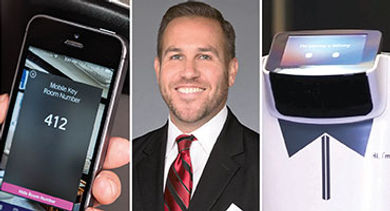
At the beginning of November, Starwood Hotels and Resorts became the first chain to let guests check in, receive their room numbers, bypass the front desk, and unlock their door using an app on their smartphones. The feature, SPG Keyless, is available at 10 Aloft, Element, and W hotels so far and will expand to 150 properties in those brands by the end of next year - covering some 30,000 doors in all.
"Not only does SPG Keyless alleviate a perennial pain point for travelers, it also transforms the first interaction with our guests from one that is transactional to something more personal," says Frits van Paasschen, Starwood's president and chief executive officer. "This is just the beginning, because through mobile we have the opportunity to marry 'high tech' and 'high touch' to transform the hotel experience in many exciting ways."
For its part, Marriott has an app that enables guests to check-in at 330 of its North American hotels. By the end of the year, this app will be available at 4,000 hotels worldwide.
R.J. Apana, director of travel and corporate events for Apogee Physicians, the United States' largest privately held hospitalist company - its physicians and nurse practitioners specialize in providing comprehensive care for hospitalized patients - has urged a move in this direction through the numerous hotel advisory boards and focus groups he sits on. "This is a good change for guests, especially meeting attendees who are often on tight schedules. It makes it possible for them to skip the line at the front desk and go straight to the room," he says.
But renovations like that do not come cheap. "Take Starwood. The lock mechanisms will have to be changed on every door to accommodate this new feature," observes Hanson.
Apana agrees but adds that "after the initial investment in the renovation, it will save the hotels a great deal of money by eliminating the need to create actual room keys."
Aloft Hotels was designed to be tech-forward from the ground up with the necessary infrastructure that allows the brand to experiment with emerging technology. Its latest innovation is Botlr, a robotic butler that buzzes around the Aloft Cupertino handling small tasks and in-room deliveries.
"This is currently a pilot and is under consideration to be implemented at Aloft Sunnyvale when it opens at the end of this year, although this has not yet been confirmed. Based on its success, we will look to roll it out at our nearly 100 hotels around the world in 2015 and beyond,"says Brian McGuinness, global brand leader, Starwood's Specialty Select Brands.
The Advisory Board Connection
One of the ways hotel companies make sure they are spending money on the right renovations is with customer advisory boards. These panels are "a good thing for the industry. Instead of guessing what customers want, we ask them," says Nancy Morrell Swanson, president of Global Marketing Services, a marketing company that facilitates advisory boards and focus groups.
"These boards are a way for hoteliers to get our candid and honest opinion on trends and the future," says R.J. Apana, director of travel and corporate events for Apogee Physicians, who sits on several hotel advisory boards. "We spend a lot of money at hotels, so we know the good, the bad, and the ugly of what is going on in them. Rather than pay a marketing team, why not reach out to one's best customers to get ideas and feedback?"
Customer advisory boards are an ongoing process. In most cases, members serve at least three-year terms.
"The purpose of the customer advisory board is to get feedback that will help produce better products, services, materials, and focus. If the suggestions are taken to heart, all of that will generate more business," says Terri Breining, managing partner with Global Marketing Services.
A management team that really cares about the customer's input is essential to a strong, productive advisory board. "I've known of groups that view a customer advisory board as a fam [trip] dressed up as an advisory board, and who place primary emphasis on how much business is booked by those around the table. There is almost always more business booked by customer advisory board members, but that is a bonus outcome, not the primary reason for its existence," explains Breining.
Hotel customer advisory boards are win-win as the hotel gets the input of the meeting professional and he or she in turn learns about the property. "There have been times our comments have really resonated and the hotel has gone back to drawing board and redesigned the meeting space," recalls C. James Trombino, executive director and CEO of Metal Powder Industries Federation, an international trade organization representing companies serving the powder metallurgy and advanced particulate materials industries. Trombino has served on a variety of hotel advisory boards for companies such as Starwood Hotels, Sonesta Hotels, Fairmont Hotels and Resorts, and Walt Disney World Swan and Dolphin Resort as well as Walt Disney World itself.
These boards are also great for relationship building. "You get really close to a hotel when you are working with the senior staff advising them on the ins and outs of design and marketing," says Trombino."You become a partner of the hotel and if you can give them business of course you do."
That's exactly what happened on several occasions over the years and again this May as the powder metallurgy industry gathered at the Walt Disney World Swan and Dolphin Resort for the PM2014 World Congress. Over 1,500 industry representatives from 40 countries attended this event.
Many advisory boards focus on future trends. "The advisory boards that I have served on were often about strategy to reach the group meetings market," says Steve Kinsley, president of Kinsley, a meetings and events management firm.
There are some boards that have been instrumental to renovations. In 2010, Omni Hotels & Resorts purchased The Amelia Island Plantation, desperately in need of a renovation. Before embarking on the project, Omni gathered its customer advisory board at the property.
"We asked for their input as to what direction the renovation should take," explains Tom Faust, vice president, sales, Omni Hotels & Resorts. "We spent a lot of time talking about guest rooms, bathrooms, and meeting space. We learned that covered walkways were important and that the new space fit seamlessly with the old."
In the spring, the group gathered at the property again to see the results of its $85 million renovation. Omni's customer advisory boards meet twice a year and each member must serve a minimum of two years. There are 50 Omni customer advisory board members and anywhere from 20 to 30 participate in each gathering. "It's time consuming and we devote a lot of resources to them, but it's worth it," says Faust.
2. Lobbies to Congregate In
Lobby redesign is a recurrent theme in hotel renovations today. "The concept of the lobby is currently being redefined as a gathering place that is used like a guest's living room would be in their own homes," says Barb Taylor Carpender, managing director of Global Marketing Services for Starwood and manager of two of Starwood's customer advisory boards.
The best hotel lobbies have a sense of place. "Today's hotel lobbies can host informal meetings and are definitely gathering spaces," explains Lowrey. "They should speak to the unique character of their location. That sense of localness is important as guests today want to feel where they are, to be a part of that community, to give unique color to their overall experience."
The Le Mériden Hub is a new concept that re-interprets the hotel lobby as a social gathering place. Communal seating stimulates interaction. A highlight is an espresso machine with a barista crafting signature coffees. Guests can enjoy local culinary offerings in a coffeehouse environment by day and a wine-inspired setting by night.
 Healthy grab-and-go dining in hotels is a focus,
says Patrick Chiappetta, vice president,
restaurants and bars, Denihan Hospitality
Healthy grab-and-go dining in hotels is a focus,
says Patrick Chiappetta, vice president,
restaurants and bars, Denihan Hospitality
"Starwood has long been an innovator in the transformation of the traditional hotel lobby," says Eva Ziegler, global brand leader, Le Méridien and W Hotels Worldwide. "More than 13 years ago when Starwood launched the W brand, our lobbies became 'living rooms,' and soon after, Sheraton brought people together with the Link@Sheraton. Le Méridien's Hub concept, which will further evolve our new brand direction, is designed to appeal to the creative class."
Many hotel companies are integrating the business center into the lobby, with computers and printers available in open, multi-purpose spaces. "Business centers existed when large desktop computers were needed," recalls Patrick Chiappetta, vice president, restaurants and bars, for Denihan Hospitality, which owns and/or operates 14 boutique hotels in major urban markets throughout the United States. "Today, travelers have business centers in their bags. All they need is Wi Fi and some outlets and they are ready to work."
3. Dining With the Stars - Or on the Run
The New York Hilton Midtown made national headlines when it eliminated room service. Apana has taken part in advisory-board discussions about this very subject. "I was kind of surprised about this. However, it does make sense with Gen Y now being the prevalent business travelers," Apana says. "They like to get out and grab a bite, not sit in the hotel room with a burger. They'd rather go to a local pub or check Yelp for recommendations for a restaurant nearby than order room service."
That's why properties are spending money to create more casual establishments where guests can get a quick bite and where there is communal seating with Wi-Fi and plenty of outlets. Although fast and casual, the offerings must also be healthy.
"There is a big focus on quick options, on grab-and-go, and how we can supply that and create energy in our lobbies at the same time," according to Chiappetta. "We have done this at all our Affinia properties. There is a grab-and-go next to all our check-ins."
While this casual trend is happening, Hanson says many successful hotels are still investing in food and beverage outlets that feature high-end dining concepts and tap into the celebrity-chef craze.
"Signature hotel restaurants are important to me and to the groups I book meetings for. If there is a celebrity chef at the helm, that is even better," says Norma McGrody, president of Meeting Management Associates (MMA), a New York City-based meeting, incentive, and special event planning company. "Everyone appreciates innovative hotel dining, especially if the program is a sales meeting or advisory board. Attendees will dine in the hotel - a convenience - since meetings often continue throughout the evening."
Hi-Tech Advice
When deciding what elements should be included in a renovation, hotels are turning their sights to social media. Red Roof Inn recently spent $150 million to renovate 150 properties, and Trip Advisor reviews were the main motivation for the upgrades. Marina MacDonald, chief marketing officer, gets every single Trip Advisor review sent to her phone.
Guests are quick to complain on travel review websites about their experiences and they usually don't hold back. "Social media is in many cases driving capital expenditure budgets and where the monies are being spent. It is supplementing the traditional form of focus group, which is not going away as it is still a valuable piece of the puzzle," explains Bjorn Hanson, Ph.D., clinical professor at the Preston Robert Tisch Center for Hospitality and Tourism at New York University's School of Professional Studies. "Social media doesn't solve it all. Focus groups don't solve it all. These two vehicles in combination are used to collect information to make better decisions."
The user-generated content on travel review websites is critical to hotels, especially given the fact that 90 percent of consumers say buying decisions are influenced by online reviews, according to research firm Dimensional Research.
"We take this feedback very seriously," says Tom Faust, vice president, sales, Omni Hotels & Resorts.
4. The Need for Flexible Meeting Space
"The biggest issue I have had over the years is how hotels design and allocate meeting space," says C. James Trombino, executive director and CEO of the Metal Powder Industries Federation, who has served on a variety of hotel advisory boards. "In the past, it's been common for a property to have three very large ballrooms but almost no breakout space."
The meeting space coming online during this current renovation wave does not have this issue, as it is easily customized and personalized. It fosters collaboration with technology integrated into an environment that encourages productive work. Soft seating that can easily be moved, spaces to write on the walls, ballrooms that are blank canvases and can be easily customized, and more social networking spaces are prevalent.
As hotels continue the surge in spending on renovations, groups meeting over the next few years can expect new experiences through upgraded technology, lobby transformations, and flexible environments for meals and meetings.
 Nancy Morrell-Swanson, president
Global Marketing Services, Inc.
Nancy Morrell-Swanson, president
Global Marketing Services, Inc."We're very fortunate right now that a lot of innovative hotel designers are working to make the guest and meeting attendee experience more meaningful," says Nancy Morrell-Swanson, president of Global Marketing Services, Inc. "But in the end, it's up to the meeting planner to put it all together. Meeting professionals plan meetings, not room designers. They know how meeting space works best."
Questions or comments? Email [email protected]
This article appears in the December 2014 issue of Successful Meetings.