A breeze sends a light mist of water to my face as I hunker down in a speeding motorized dug-out canoe. I defocus my eyes and faraway trees and mountains turn into a fantastic green blur as we shoot toward the village of Parara Puru to visit the Embera Indian tribe, about two hours outside Panama City. In the last couple of years, ecotourism has exploded here in Central America, and the executive team at the new Riu Panama Plaza luxury hotel has arranged lunch with the tribe, participation in its traditional celebrative dance, and a visit to the nearby Rio Chagres waterfalls.
Chomping down on the customary Embera lunch of plantains and freshly fried fish wrapped in a thick leaf, every morsel is crisp yet tender and feathery. As I eat, a canine member of the tribe greets visitors with tail wags and motions for pats on the head, while an Embera boy frolics in the river near my familiarization group’s docked canoe. I am getting the full flavor of indigenous Panama.
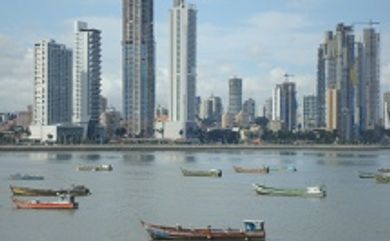
While Panama is welcoming the huge influx of natural tourism, the Central American republic, with its famous Canal that joins the Atlantic and Pacific oceans, is a vital international shipping and commerce link, a high-traffic gateway on the isthmus between North America and South America. Its capital, Panama City, with a population of more than 1 million, is a still-rising metropolis, just by glancing the nest of construction cranes and scaffolds intertwined with finished condo high-rises and skyscrapers bearing names of banks—some locals call it “Little Miami.” Which is why Spain-based Riu Hotels & Resorts, active in 20 countries, sited its first hotel in Panama here in order to capture the busy meetings and business travel market, as part of its new Riu Plaza urban chain.
“Our main markets are the U.S. and Colombia,” says Carlos Cordoba, director of sales for the Riu Panama Plaza, before adding, “and the Central American offices of the major pharma companies.” Opened in September, in the heart of the city's financial district, the 645-room hotel has more than 50,000 square feet of contemporarily styled indoor and outdoor meeting space for a total group capacity of 1,300. “We’ve created a product that’s above and beyond expectations for Panama,” Cordoba says of the property, a hulking, blue-glass tower with 35 floors.
One of the hotel’s meeting floors consists of two prefunction spaces and 12 confab rooms with European monikers; the first five rooms make up the 10,311-square-foot Barcelona Room. But the highlight is the patriotically named Panama Grand Salon, a 14,464-square-foot ballroom/banquet room divisible by four—Cordoba says it is the country’s largest hotel banquet space. Another primary space is the equally grand event terrace measuring 18,514 square feet.
On ground level, the lobby elicits thoughts of urban Miami chic, with a chocolate-brown front desk, dark-colored sitting areas with contrasting white cushions, orange accent lighting everywhere, and a kaleidoscope of decorative touches. There is a hanging, rainfall-inspired light ornament that commands attention. All four of the hotel’s restaurants abut the lobby—as does the Riu Class Executive Lounge—and feature ultra-contemporary decor, especially the funky, purple-soaked Sushi Lounge and Lobby Bar Studio 50.
Riu Panama Plaza’s standard (called deluxe) guest rooms have either brown/orange or brown/mint green color themes (mine was the latter), and each features a double bed, a generous living/sitting area with a couch and work desk, a tastefully fitted bathroom with a tub and dual sinks, complimentary wireless Internet, and a 32-inch flat-screen TV mounted on the wall. The hotel also has deluxe rooms with king beds, even larger executve rooms with double or king beds, 30 suites of more than 800 square feet each, two 1,300-square-foot presidential suites, and three gargantuan penthouses (2,800 to 3,300 square feet over two stories) fit for a king (or your group’s top VIP)—one of which the hotel’s executives showcased using a cocktail party.
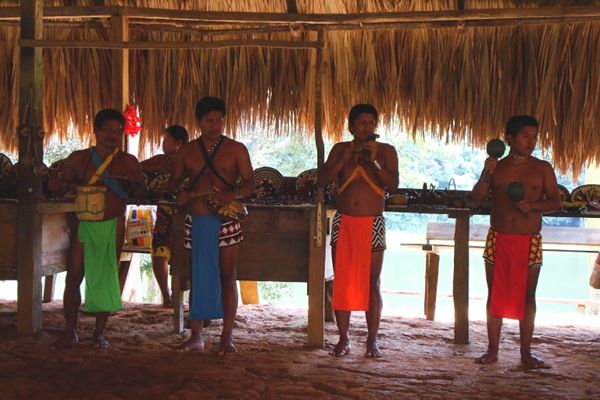
Men of the Embera tribe begin playing music for a celebrative dance
Over three days, the Riu Hotels & Resorts team demonstrated the best of what Panama provides visiting meeting groups away from its $135 million downtown hotel: the lush tropical rainforests of Chagres National Park, both high-end-mall and local handicraft shopping, UNESCO World Heritage Sites, and the famous Panama Canal. Our jaunt to Parara Puru and the national park was capped off by a cooling afternoon shower while trekking to the waterfalls in mid-80-degree weather.
No trip to Panama is complete without seeing the Canal, of course. One morning, my group and I hop on our van, which, on the way, jousts with Hyundais, BMWs, and the diablo rojo (“red devils”)—public buses colorfully painted with murals of Latin entertainers or politicians—and step into the Miraflores Visitors Center about a half-hour later. Jaime Robleto, a guide whose English has nary an accent, greets the group and leads us through the Canal’s four-story museum.
We browse exhibits and scale models showing the Canal’s layout and the mass of humanity who endured or perished from malaria and yellow fever while building the shipping path on two separate attempts between 1880 and 1914, when it was officially inaugurated. More than 27,000 men sacrificed their lives in order to let transoceanic cargo and passenger vessels avoid going around South America and cut travel time by more than half. On the tour, Robleto dishes out Canal tidbits: 36 species of fish live here … ship tolls range from several hundred dollars to several hundred-thousand dollars … 200 inches of yearly rainfall refresh the water supply essential to the Canal’s operation … it takes a ship eight to 10 hours on average to cut across the 50-mile engineering marvel from ocean to ocean.
After we learn about the $5.3 billion expansion project that will add a new set of locks to each of the Miraflores (Pacific-side) and Gatun (Atlantic-side) lock systems in time for the Canal’s centennial in 2014, we step out onto the observation deck to watch a container ship transfer through the Miraflores Locks before enjoying an al fresco buffet lunch on the terrace of Miraflores Restaurant. Most areas of the visitors center, including the restaurant, three observation terraces, and a fully equipped theater, are available for group rentals.
Heading for the Atlantic Ocean, the Cap Portland finishes its transfer through Miraflores Locks
Our hunger satiated, we depart the Canal, and following a coffee break, we journey to the heart of Casco Antiguo (also referred to as Casco Viejo), the Old City in Panama City. The district, with its blend of historic Caribbean and French colonial architecture, dates back to 1673 and is now a UNESCO World Heritage Site. Our first stop is the Iglesia San Jose church to view its famous Baroque-style Golden Altar, elaborately carved from mohagany and completely bedecked with gold flake, but some fam group members veer off to look at the stone-columned facade of the Iglesia de San Ignacio de la Compania de Jesus across the street before I catch up with them.
We navigate Casco Antiguo’s small, cobblestone streets and eventually end up in the district’s town square, called Plaza de la Independencia, with its white gazebo. On one side of the square stands the magnificent Catedral Metropolitana, its weathered facade flanked by two ivory white bell towers. Minutes later it was time for a group photo opportunity, as we make it to the waterfront, which boasts a panorama of Panama City’s dense skyline on the other side of Panama Bay.
The Casco Antiguo waterfront is also where the country’s Presidential Palace is located. Known as the Palace of the Heron’s, nicknamed after the birds that were brought and still reside there, the residence of President Ricardo Martinelli and his family is painted white entirely and has graceful Spanish colonial columns and balconies. While we aren’t allowed inside on this day, we all pose with wide smiles for a photo in front of the building but armed guards on the other side of the wrought iron gate surrender none of their all-business look.
The perfect complement to a tour of Casco Antiguo is an excursion to the ruins of Panama Viejo (Old Panama), the birthplace of Panama City, about two miles northeast. Founded by Spanish conquistador Pedro Arias de Avila in 1519, Panama Viejo was the first European settlement on the Pacific coast of the Americas, but was sacked by British pirate Henry Morgan in 1671, eventually forcing resettlement in Casco Antiguo. Today Panama Viejo lives on as a UNESCO site; we can still trace out its streets from the remnants, and we crane our necks to gaze at the fully intact bell tower of Cathedral de Nuestra Senora de la Asuncion.
After nightfall, Riu Panama Plaza’s executive chef, Raul Vaquerizo, serves up a multi-course gourmet dinner for us at the hotel’s Tastes restaurant. The feast consists of a mouthwatering tomato gazpacho, cheeses from the La Mancha province of Spain, plump lobster, succulent lamb in polenta, and irreverent chocolate pretzel lollipops. To refresh the palate during the meal, Vaquerizo sprinkles in interludes of a lemon tequila cocktail and a sweet dish of yams with a mango mousse/soursop cream combo looking like sunny side up eggs to resemble huevos con patatas, a popular Spanish dish.
The Golden Altar at Church of San Jose in the Old City
On a different evening, we make a 20-minute transfer to Maito Restaurant, an upscale but relaxed eatery along the bustling Calle 50 corridor. On the front deck, the group enjoys chef Mario Castrellon’s signatures like black risotto with carpaccio shrimp and juicy Angus steak amid a comfortable breeze. We spend another evening at the hotel enjoying a taste of Japan-via-Panama with Latin sushi interpretations at the Sushi Lounge.
Arriving at the hotel hungry one afternoon, I hit the Ibiza Lounge and Snack Bar by the outdoor pool for table service, ending up with a satisfying burger with fries and a cerveza. Every morning, the international breakfast buffet in the Arts and Prima restaurants is complimentary. I make regular stops to the omelet station for made-to-order plates.
The Riu Panama Plaza’s service to my guest room, meanwhile, was immediate and thorough. When I accidentally disabled my TV’s remote control on the first day, a technician rushed up to the 19th floor not once but twice to initially diagnose the issue and then retrieve the necessary tools to remedy my distress. And, for a snack, ordering a bowl of chicken soup from room service promptly produced a cauldron with seemingly limitless chunks of goodness.
The Riu Panama Plaza [External photo courtesy Riu Hotels & Resorts]
Before we depart for Tocumen International Airport on the last day, my group and I fancy ourselves with individualized massages in the Riu Panama Plaza’s four-room Renova Spa, which also has a fitness center and a beauty salon. If attendees are limited on time like we were, the Renova staff can deliver 30-minute massages to get them refreshed quickly. As I walk out of Renova, shoulder and back muscles untangled, I think to myself, “What a way to cap off an enlightening excursion to Panama.”