The first convention has pulled out of Indianapolis on the heels of a rapidly growing protest over a new law that allows businesses in Indiana to refuse service to gay customers.
Republican Gov. Mike Pence signed the Religious Freedom Restoration Act (RFRA) into law on March 26, drawing immediate protests from a number of major corporations, particularly tech firms like Salesforce.com and Apple, as well as groups ranging from a religious denomination to the National Collegiate Athletic Association (NCAA). The governor of Connecticut has issued an executive order banning government employees from traveling to the state.
The American Federation of State, County and Municipal Employees (AFSCME) 2015 Women's Conference, scheduled for Oct. 9-11 at Indianapolis' Indiana Convention Center (ICC), was cancelled on Monday "as a sign of our disgust and disappointment with Gov. Pence's discriminatory law," the union said in a statement. "The 1.6 million members of AFSCME cannot in good conscience make such a sizeable financial investment in Indiana knowing that women and men in that state are deliberately targeted for discrimination."
The musical group Wilco and the comedian Nick Offerman (known for playing Ron Swanson on NBC's Parks & Recreation) have also cancelled shows in Indiana.
On Monday, the American Society of Association Executives (ASAE) jumped into the fray with an open letter to Gov. Pence asking that his "office work with the Indiana General Assembly to adopt corrective language ... clarifying that the law does not allow discrimination of any kind against any segment of the population."
The ASAE letter continued, "ASAE stands strongly in support of diversity and inclusion practices within the association industry. Laws that permit discrimination are not only regressive, they put our members at risk of being denied service anywhere from restaurants to meeting and convention facilities, and send a harmful message that fairness, equality and the principles of our Constitution are secondary to personal prejudice. ASAE has many members, industry partners and vendors in Indiana and is concerned that the measure adopted could create an unwelcoming environment for some residents and visitors to the state."
That concern has already led the ICC's largest show, Gen Con, which attracts some 56,000 role-playing game fans and $50 million in economic impact to the center each summer, to threaten to abandon Indianapolis over the law.
Citing concerns expressed by attendees that they would face refusal of service and discrimination, Gen Con's CEO and owner, Adrian Swartout, wrote an open letter to attendees of the show saying that she has begun discussion about whether to move the show when the group's contract is up in 2021, and is reportedly putting on hold an expansion into the ICC's neighboring Lucas Oil Stadium. Organizers have also asked attendees to let them know of any instances of discrimination or negative experiences they suffer during the 2015 show
Still, Swartout said that due to "specific dialog with longtime partners in Indy, we believe that Gen Con attendees will not only receive the same great service and hospitality in 2015, but an even warmer response from the city."
Among those speaking out against the bill was Indianapolis Mayor Greg Ballard, who "expressed concerns that the measure sends 'the wrong signal' about the city and state," the Indianapolis Star wrote the day before the bill was signed into law. It also cited Ballard's concerns that the RFRA would damage the city's convention business.
In an executive order issued Monday, Ballard reaffirmed Indianapolis' policy that its vendors, contractors, and others accepting public funds not discriminate for a variety of reasons, including sexual orientation and gender identity, as well as requesting that the Indiana General Assembly and Governor add sexual orientation and gender identity to the classes protected under state law.
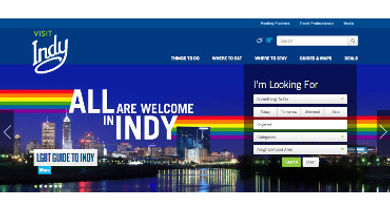
The webpage of the Indianapolis convention and visitors bureau, Visit Indy, opens with the message "All are welcome in Indy" with the six-color rainbow of the flag adopted by the gay rights movement, as well as a link to its "LGBT Guide to Indy."
A Civil Rights Issue
RFRA is described by supporters as civil rights legislation, protecting citizens and businesses from being forced to violate their religious principles. But opponents say it paves the way for legal discrimination against the LGBT community.
AFSCME, for one, cited it's historical opposition to discrimination in canceling its convention. "Throughout our proud history, our union has stood up whenever injustice has occurred -- be it for striking sanitation workers in Memphis in 1968, or for the victims of apartheid in South Africa in the 1980s," the union's letter says.
Connecticut Gov. Dannel Molloy agrees. Executive Order 45 reads, in part, "Connecticut has a long tradition of being at the forefront of protecting civil rights as well as religious freedom ... [and] certain states have enacted legislation to protect religious freedom, but do not prohibit discrimination for classes of citizens...."
The order instructs all agencies, departments, boards and commissions, and the University of Connecticut and Board of Regents to bar any publicly funded travel to any state that has a law like the RFRA on its books. He does carve out exceptions for existing contracts, as well as travel necessary to enforce state law or protect public health, welfare, and safety.
One of the first local groups to threaten to withdraw meetings and convention business from Indiana is the Christian Church (Disciples of Christ), which has had its headquarters in Indianapolis for nearly 100 years. The group is considering moving its 2017 General Assembly, which brings some 6,000 faithful to Indiananpolis, according to an open letter by the denomination's General Minister and President, the Rev. Dr. Sharon Watkins, who urged Gov. Spence to veto the RFRA.
"As a Christian church, we are particularly sensitive to the values of the One we follow -- one who sat at table with people from all walks of life, and loved them all," Watkins and other church leaders wrote in the letter to Gov. Pence. "Our members and assembly-goers are of different races and ethnicities, ages, genders and sexual orientations. They have in common that they love Jesus and seek to follow him. We are particularly distressed at the thought that, should RFRA be signed into law, some of our members and friends might not be welcome in Indiana businesses -- might experience legally sanctioned bias and rejection once so common on the basis of race."
Since the RFRA bill was signed into law, Watkins' blog on the church website tells members, "We will keep you posted (and please be patient) as we sort through the contracts, costs, and decisions around the 2017 General Assembly. We also have attorneys reviewing similar legislation in the states that are finalists for 2019 and in states where we would consider moving the 2017 General Assembly. Not all of these bills are the same and there is a lot of misinformation about each of the state laws."