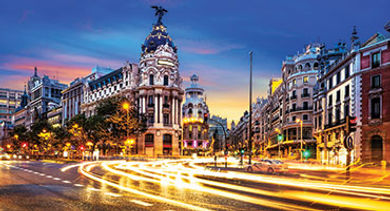
Renowned for its art and culture, Madrid is not only one of the top destinations for the meetings, conferences and conventions industry, it is also one of the safest capital cities in Europe.
According to the 2014 International Association Meetings Market report released by the International Congress and Convention Association (ICCA) in May, Madrid hosted a record 200 qualifying meetings, placing it third after Paris and Vienna, and ahead of Barcelona, which ranked fifth. Those conventions attracted 91,452 participants. There are a half-dozen conference and convention centers in Madrid, notably the 2.15 million-square-foot IFEMA-Feria de Madrid.
Madrid is a city with plenty to attract attendees. It has one of the largest collections of parks, gardens, and green spaces in the world - 172 of them, including the 4,255-acre Casa de Campo. Anchored by the world-famous Prado, Madrid is also home to many great museums, including the Reina Sofia National Museum and Art Centre and the Thyssen-Bornemisza Museum.
It is an easy city to get to, with 10 U.S. cities offering direct flights to Madrid. The second-largest subway network in Europe makes it easy to navigate. Alternatively, Madrid's BiciMAD bike sharing service began offering inexpensive access to 1,560 electric bicycles last year at 123 stations around the city.
On the gastronomy front, Madrid is like most major Spanish cities in that the prime dinner hour is quite late - generally 10 p.m. or so. It offers a dozen Michelin-starred restaurants - led by the three-star DiverXO - as well as a baker's dozen that are at least a century old. One of these, Botin, is said to be the oldest restaurant in the world, having opened in 1725. It is mentioned in not one but two of Ernest Hemingway's works, The Sun Also Rises and Death in the Afternoon.
Questions or comments? Email [email protected]
This article appears in the October 2015 issue of Successful Meetings.