According to the most recent "National Community Preference Survey," published in 2013 by The National Association of Realtors, 60 percent of homebuyers favor neighborhoods with a mix of houses, stores, and other businesses that are within walking distance. With the American population increasingly opting to live in cities over suburbs, it's no surprise that people want to meet in livelier areas too.
"It's all about the experience," observes Greg O'Dell, president and CEO of Events DC, the official convention and sports authority for the District of Columbia. "Meeting attendees today want to have memorable experiences, and we've spent a lot of time focused on trying to create those experiences."
Those experiences don't just take place in the convention center, but also in the downtown neighborhoods beyond it, where rampant development is helping cities like Washington, D.C., attract new residents and visitors alike. Here are three shining examples that promise to redefine the group product in some of America's most popular meeting destinations.
1. Washington, D.C.: Shaw/U Street Revitalization
A century ago, Washington, D.C.'s "Uptown" neighborhood was a thriving center of District culture and community. Following the 1968 assassination of Martin Luther King, Jr., however, the neighborhood around U Street -- once home to Jazz legend Duke Ellington -- erupted into riots, catalyzing a decades-long decline.
When the six-block Walter E. Washington Convention Center opened in 2003, it was part of a city-led effort to revitalize the area, now called "Shaw," by bringing in visitors and stimulating development. Unfortunately, the effort began with a crawl instead of a sprint, acknowledges O'Dell.
"When we first built our building 13 years ago, our architects and those who were planning the building had great intentions," O'Dell says, emphasizing a series of 11 exterior retail spaces along the convention center's perimeter, which were intended to "activate" the local community by attracting commerce serving local residents. "But having said that, we also had some challenges. For one, the spaces could only be accessed from the outside; they don't connect to the inside of the building. Two, they're somewhat limited in size. Finally, the neighborhood around us had not matured yet. So, we found ourselves making creative use of those spaces [for art installations, for example, and a pop-up fashion show] until the market was right to lease them."
When the market finally reached a ripened state in fall 2015, Events DC launched an aggressive campaign to lease the convention center's long-vacant retail spaces, which total 19,000 square feet. As a result, it brought on six new tenants in addition to an existing tenant: a Sbarro pizzeria.
"We were extremely pleased and exceeded our expectations," reports O'Dell, who says new tenants include Unconventional Diner, a locally owned and operated high-end diner concept that is the brainchild of two D.C. residents/business owners; Union Kitchen Grocery, a locally inspired corner market; Smoked & Stacked, a fast-casual sandwich shop by Top Chef season 13 contestant Marojorie Meek-Bradley, showcasing in-house brined and smoked pastrami; Morris, a craft cocktail bar from D.C.-based chef and restaurateur Spike Mendelsohn, another "Top Chef" alumnus; Urban Athletic Club and Composition ID, a boutique fitness center; and an upscale barbershop.
With vacant storefronts filled, Events DC's next priority in the neighborhood is the streetscape, which it plans to enhance with new public art installations, lighting, vertical plant installations, and seating areas. "We're looking for ways to create a sense of place around the building," O'Dell continues. "It speaks to the current evolution in convention space. People aren't just sitting in plenary sessions anymore; they want to be able to interact with each other, and we want to create a forum for them to do that both in and around our building."
Elsewhere in the city, other projects are revitalizing neglected neighborhoods in much the same way that the convention center is revitalizing Shaw. On the eastern edge of D.C.'s Capitol Hill neighborhood, for example, Events DC plans to redevelop a 190-acre parcel that's currently home to the 55-year-old RFK Stadium; when the decrepit stadium is razed, it will make way for public athletic fields, a market, and a family sports-and-entertainment complex, and perhaps even a new NFL stadium for the Washington Redskins.
Meanwhile, in the District's underserved Ward 8 neighborhood, a new 118,000-square foot, 5,000-seat basketball arena for the Washington Wizards and Washington Mystics will host more than 90 non-basketball events -- including concerts and cultural events -- every year when it opens in fall 2018.
"We have a tremendous amount of international travelers who come here, so it's in that context that we think about what attractions and experiences we want to create in the District," O'Dell says. "The things we're doing today will help us attract people from across the global to our city tomorrow."
2. Miami: Miami Worldcenter
Because it sits at a crossroads between North and South America, Miami is without question a globally significant city. Historically, however, its downtown has felt rather insignificant. Absent modern amenities like shopping and nightlife, visitors and locals alike forsook downtown and flocked, instead, to nearby Miami Beach for a vibe that's more "Miami" than downtown has ever been.
A massive new development immediately north of Miami's Central Business District, extending between 2nd and Miami Avenues to 11th Street, promises to change that. Called Miami Worldcenter, the 27-acre, 10-block development broke ground last month and is one of the largest development projects in South Florida history. When its first phase is complete in late 2018, the "city within a city" will have a luxury open-air shopping pavilion akin to Lincoln Road in South Beach, with 450,000 square feet of retail space punctuated by public promenades and plazas; 4.5 acres of open space; several residential towers with luxury condos and rentals, including the 58-story, 513-unit Paramount Miami Worldcenter; numerous dining and entertainment options; and a Marriott Marquis hotel and convention with 1,800 guest rooms and 600,000 square feet of meeting, exhibition, and convention space, including an 80,000-square-foot outdoor event deck.
"Our robust sales have reaffirmed our belief that a new generation of domestic and international buyers want to live, work, and play in the heart of downtown Miami," Daniel Kodsi, developer of Paramount Miami Worldcenter, said in a statement last month.
That same generation of buyers wants to meet downtown, too, according to Joseph Herndon, vice president of MDM Group, developer of the Marriott Marquis Miami Worldcenter Hotel & Expo Center, which is scheduled to open in fall 2018. "The Marriott Marquis Miami Worldcenter Hotel & Expo Center is a true game-changer for this region," he said upon announcing the hotel last spring. "The property allows us to compete for significant domestic and international conferences and events, and consequently will help generate the global recognition which this city deserves."
3. New York: Hudson Yards
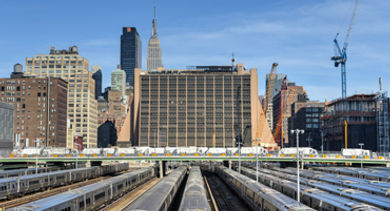
For more than half a century, city planners have been trying to develop Hudson Yards, a blighted area on the West Side of Manhattan that's long been dominated by rail yards and transportation infrastructure. As far back as 1956, developers have had visions of turning the area into a grandiose community overlooking the Hudson River. Time and again, however, banks unwilling to finance such an ambitious project have rained on their parade, leaving the working rail yards to rust while the rest of Manhattan flourished.
Developers and city officials finally triumphed in 2012, when construction crews broke ground on the largest private development in the history of not only the city, but also the country.
Scheduled for completion in 2024, the $15 billion, 26-acre Hudson Yards project will comprise 20 million square feet of offices, apartments, and retail outlets, much of which will be built atop two "platforms" constructed over the existing rail yards, which will remain in use. The result: a new New York neighborhood that's being built, basically, from scratch.
"Developing Manhattan's final frontier is the next major step in our city's ongoing economic revival," then-Mayor Michael Bloomberg said at the project's groundbreaking ceremony in 2012. "The Hudson Yards project -- whose construction will create 23,000 jobs alone and whose existence will support thousands more -- is a testament to our city's economic strength."
The neighborhood's highlights will include more than 100 new shops and restaurants, including a collection of 12 eateries curated by Chef Thomas Keller; approximately 5,000 new residences; 14 acres of public open space, including numerous parks and plazas; a 750-seat public school; the first-ever Equinox-branded "fitness hotel," with approximately 200 luxury guest rooms, a 60,000-square-foot fitness club, a spa, and several meeting and event spaces; and Culture Shed, a six-story cultural center that will boast 40,000 square feet of column-free exhibition space and a 16,000-square-foot expandable "shed" that will expand and contract to accommodate many different types of events and audiences.
"The history of our city has been defined by a series of moments where dreamers dug deep into their imagination, challenged the realm of possibility, and brought the seemingly unachievable to life. For 21st Century New York, today is our moment as we start the Hudson Yards, one of the most ambitious developments ever undertaken in the country," concluded Stephen Ross, founder and president of Hudson Yards developer Related Companies, at the project's groundbreaking. "Hudson Yards will be the new heart of New York City with state-of-the-art commercial space, vibrant retail and restaurants, a unique cultural center, over a dozen acres of public space with iconic plazas and important public art, a school, residences, and affordable housing … Today we see our collective vision come to life and we again establish that when New Yorkers come together, nothing can stop us."